
Introduction
The University of Al-Maarif (UOA) is deeply committed to sustainable resource management, environmental responsibility, and efficient water use as part of its institutional mission to advance sustainability in higher education. Situated in Al-Anbar, Iraq, a region characterized by arid conditions and periodic water shortages, UOA recognizes the urgent necessity of implementing policies that conserve water, promote reuse, and ensure long-term ecological resilience.
To this end, UOA has adopted a Comprehensive Water Reuse Policy (WRP-2024) that governs the collection, treatment, and utilization of water resources across its campus facilities. This policy aligns with UN SDG 6 (Clean Water and Sanitation) — particularly Target 6.4, which emphasizes “substantially increasing water-use efficiency across all sectors and ensuring sustainable withdrawals and supply of freshwater.” It also contributes to SDG 9 (Industry, Innovation, and Infrastructure), SDG 11 (Sustainable Cities and Communities), and SDG 12 (Responsible Consumption and Production).
The policy provides a structured framework for managing all stages of water reuse — from treatment and monitoring to distribution and awareness — while integrating sustainability education into the university’s curriculum and research agenda. Through its Water Reuse Policy, UOA seeks to serve as a model of eco-conscious governance and innovation in Iraq’s higher education sector.
1. Policy Vision and Objectives
Vision
To establish the University of Al-Maarif as a national leader in sustainable water management through innovation, education, and efficient reuse systems that reduce dependency on external water supplies and support environmental balance.
Mission
To conserve natural water resources by implementing a closed-loop system of water collection, treatment, and reuse within all university operations, while promoting water awareness and sustainable practices among the university community and the wider society.
Objectives
- Reduce overall water consumption through the recovery and reuse of treated wastewater and greywater.
- Promote sustainable practices by integrating water management principles into academic programs and operational strategies.
- Ensure compliance with national and international water quality standards.
- Enhance community engagement through educational programs on water sustainability.
- Document and measure the environmental, social, and economic benefits of water reuse initiatives.
2. Scope of Application
The Water Reuse Policy applies to all UOA facilities, including:
- Academic buildings and laboratories
- Administrative offices
- Dormitories and cafeterias
- Sports complexes and landscaping areas
- Maintenance and cleaning operations
- On-campus research centers and future development sites
All departments are required to follow the principles outlined in the policy to ensure uniform implementation and reporting of water-related activities.
3. Institutional Framework and Governance
The implementation and monitoring of the Water Reuse Policy are coordinated by the Sustainability and Global Ranking Unit (SGRU), in cooperation with:
- Engineering and Maintenance Department – Oversees water treatment infrastructure, system maintenance, and metering.
- College of Engineering – Provides technical expertise, designs, and performance evaluations.
- Environmental and Health Safety Committee (EHSC) – Monitors water quality compliance and safety.
- Deanship of Student Affairs – Promotes awareness among students and staff.
The Vice President for Administrative Affairs chairs the Water Management Steering Committee, which convenes quarterly to evaluate progress, review metrics, and approve new initiatives related to water efficiency and sustainability.
4. Policy Components
The University of Al-Maarif’s Water Reuse Policy is structured around five core components:
- Collection and Segregation
- Treatment and Storage
- Reuse and Distribution
- Quality Control and Compliance
- Awareness, Training, and Reporting
5. Water Collection and Segregation
5.1 Sources of Water for Reuse
UOA’s reuse system collects water from the following sources:
- Greywater: From handwashing stations, showers, and sinks in dormitories and laboratories.
- Blackwater: From restrooms and cafeterias, directed to the treatment facility.
- Condensate: Captured from air-conditioning systems.
- Rainwater and Storm Runoff: Collected from rooftops and hardscapes for storage and later reuse.
5.2 Collection Infrastructure
An integrated dual-piping network ensures the segregation of potable and non-potable water. Dedicated pipelines carry wastewater to the on-campus treatment plant, where water is processed according to usage requirements.
6. Water Treatment and Storage
6.1 Treatment Process
The university’s treatment plant employs a three-stage process:
- Primary Treatment – Screening and sedimentation to remove solids.
- Secondary Treatment – Biological treatment through activated sludge systems.
- Tertiary Treatment – Filtration and disinfection (chlorination and UV radiation).
6.2 Storage Facilities
Post-treatment, the water is stored in reuse reservoirs with a total capacity of 250 cubic meters. These tanks are inspected biweekly for water quality and operational efficiency.
6.3 Treatment Plant Capacity
The facility is designed to process approximately 80 cubic meters per day, covering a significant portion of irrigation and cleaning needs while reducing reliance on municipal sources by an estimated 45%.
7. Water Reuse Applications
The University of Al-Maarif prioritizes non-potable reuse applications to maximize water conservation while maintaining safety and hygiene.
7.1 Irrigation and Landscaping
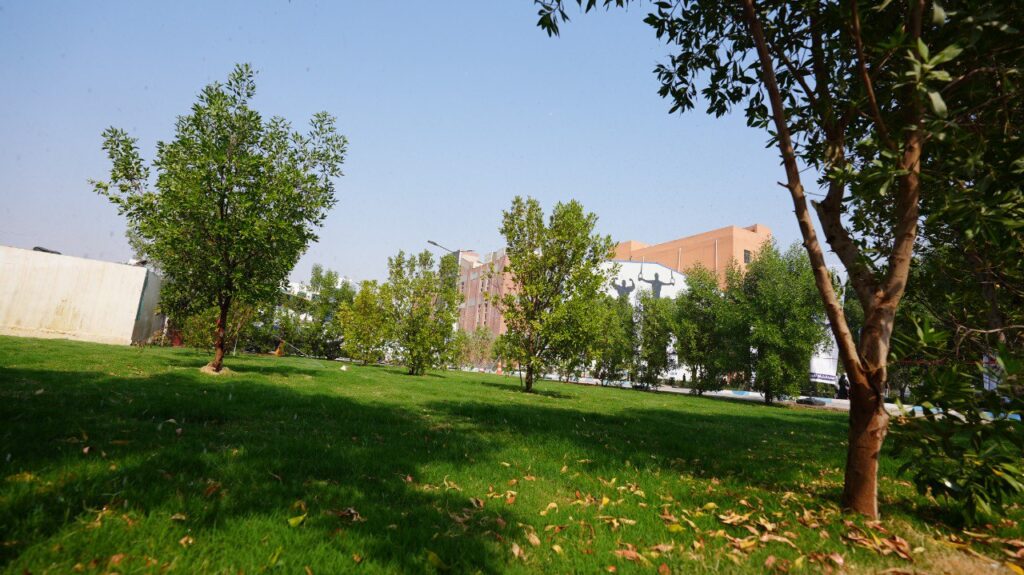
- Treated water irrigates over 65,000 m² of green spaces, including lawns, trees, and sports grounds.
- Smart irrigation systems with humidity sensors optimize water distribution and reduce waste.
7.2 Cleaning and Maintenance
Reused water is utilized for:
- Pavement and building cleaning
- Dust suppression
- Maintenance of outdoor facilities
7.3 Cooling Systems
Reclaimed water is used for cooling towers and HVAC systems, minimizing freshwater consumption in energy-intensive facilities.
7.4 Construction Activities
For ongoing campus expansion, treated water supports construction mixing, cleaning, and site preparation, reducing demand for fresh water in building operations.
8. Quality Control and Compliance
8.1 Water Quality Standards
All reused water must meet the Iraqi Environmental Standards for Non-Potable Water Use, as well as the World Health Organization (WHO) guidelines. The Environmental Health and Safety Committee oversees periodic laboratory testing.
8.2 Testing Parameters
Regular water analysis includes:
- Physical indicators (pH, temperature, turbidity)
- Chemical indicators (COD, BOD, TDS, nitrates, chlorides)
- Biological indicators (E. coli, coliforms)
8.3 Testing Frequency
- Weekly monitoring for basic indicators
- Monthly full laboratory analysis
- Quarterly compliance reporting submitted to the Ministry of Environment
Results are published annually in the UOA Sustainability Report.
9. Monitoring and Measurement
9.1 Digital Metering System
All treated water outlets are equipped with IoT-enabled flow meters that measure:
- Daily and cumulative flow rates
- Pressure and temperature data
- Distribution efficiency
Data is transmitted to the Water Management Dashboard, providing real-time insights for maintenance and optimization.
9.2 Performance Indicators
Key metrics tracked include:
| Indicator | Target (2025) | Current (2024) |
|---|---|---|
| % of total water reused | ≥ 50% | 47.5% |
| Volume of treated wastewater reused (m³/year) | 28,000 | 24,700 |
| Reduction in municipal water dependency | 40% | 37% |
| Water reuse efficiency (treated vs. used) | ≥ 95% | 92% |
9.3 Annual Audits
The Facilities and Maintenance Unit conducts annual audits to verify the data and identify opportunities for system upgrades.
10. Education and Awareness
The University of Al-Maarif integrates water reuse education into its academic and cultural framework.
10.1 Academic Integration
Courses on environmental engineering, sustainability management, and water treatment technologies include modules on practical water reuse systems. Students conduct site visits and participate in operational monitoring.
10.2 Awareness Campaigns
Annual campaigns under the themes “Every Drop Counts” and “Water for the Future” are organized, featuring:
- Student exhibitions and competitions
- Educational videos and posters
- Interactive workshops on water-saving habits
10.3 Community Engagement
UOA extends its awareness efforts to schools and local communities, providing lectures on household water reuse and efficient irrigation practices.
11. Research and Innovation in Water Reuse
11.1 Faculty Research
The College of Engineering and College of Allied Medical Sciences collaborate on projects studying:
- Greywater filtration using natural materials
- Solar-powered water purification systems
- Artificial intelligence for predictive maintenance
11.2 Student Innovation
Students develop prototypes and research papers on low-cost water reuse technologies, contributing to Iraq’s scientific advancement in sustainable engineering.
11.3 Partnerships
UOA partners with:
- University of Anbar and University of Baghdad for joint research
- Ministry of Water Resources for pilot testing
- Private companies for technology transfer and system upgrades
12. Reporting and Transparency
All data and performance metrics related to water reuse are compiled annually by the Sustainability and Global Ranking Unit. The findings are presented in the UOA Annual Sustainability Report, which includes:
- Volume of water treated and reused
- Operational efficiency statistics
- Environmental impact summaries
- Research outputs and community outreach data
These reports are publicly accessible through the university’s Sustainability Portal, ensuring transparency and accountability.
13. Policy Implementation Mechanisms
13.1 Training Programs
All facility management staff receive annual training on:
- Operation of water treatment equipment
- Safety protocols for reuse systems
- Emergency procedures in case of contamination
13.2 Incentives
Departments that demonstrate measurable reductions in water use are recognized under the UOA Green Campus Awards, motivating sustainable performance.
13.3 Corrective Measures
Any deviations from policy requirements trigger an internal review and corrective plan. Persistent non-compliance may result in administrative action.
14. Economic and Environmental Impact
14.1 Environmental Benefits
- Reduction of 30,000+ cubic meters of water drawn from municipal sources annually.
- Decrease in waterborne pollution discharge.
- Increased soil and vegetation health through controlled irrigation.
14.2 Economic Benefits
- 25% reduction in annual water expenditure.
- Energy savings from optimized pumping systems.
- Enhanced operational efficiency and reduced maintenance costs.
14.3 Social Impact
- Enhanced environmental literacy among students.
- Contribution to national sustainability goals and local resilience.
- Strengthened community partnerships for water management.
15. Policy Review and Continuous Improvement
The Water Reuse Policy is reviewed every two years by the Water Management Steering Committee. The review process includes:
- Evaluation of quantitative and qualitative outcomes.
- Assessment of system upgrades and technological advancements.
- Recommendations for expansion or integration of new reuse technologies.
- Updating procedures to reflect evolving sustainability standards.
The 2025 review will focus on expanding smart irrigation systems, rainwater harvesting, and AI-based leak detection.
16. Alignment with the Sustainable Development Goals (SDGs)
| SDG | Contribution of the UOA Water Reuse Policy |
|---|---|
| SDG 6 – Clean Water and Sanitation | Increases water-use efficiency, promotes treatment and safe reuse. |
| SDG 9 – Industry, Innovation, and Infrastructure | Encourages research and innovation in sustainable water technologies. |
| SDG 11 – Sustainable Cities and Communities | Enhances urban resilience through eco-friendly infrastructure. |
| SDG 12 – Responsible Consumption and Production | Fosters resource conservation and sustainable operations. |
| SDG 13 – Climate Action | Reduces environmental footprint and strengthens climate adaptation capacity. |
| SDG 17 – Partnerships for the Goals | Promotes collaboration between academia, government, and industry. |
17. Future Strategic Directions
The University of Al-Maarif aims to further advance its water sustainability initiatives by pursuing the following strategies:
- Integration of AI-based Water Management: Developing predictive systems for leak detection and flow optimization.
- Expansion of Reuse Systems: Extending greywater reuse to dormitories and new campus facilities.
- Rainwater Harvesting: Implementing rooftop collection systems for irrigation use.
- Renewable Energy Integration: Powering water treatment plants with solar panels to reduce carbon emissions.
- Regional Water Education Center: Establishing a hub for research, training, and public engagement in sustainable water management.
These initiatives are part of UOA’s Sustainability Vision 2030, ensuring long-term environmental stewardship and resilience in higher education.
Conclusion
The University of Al-Maarif (UOA) demonstrates unwavering commitment to sustainable resource management through its comprehensive Water Reuse Policy (WRP-2024). By integrating technological innovation, education, and community engagement, the university ensures that every stage of water use — from collection to reuse — contributes to environmental protection, cost efficiency, and social well-being.
This policy not only supports Iraq’s national goals for sustainable development but also positions UOA as a model of responsible higher education in the Arab region. Through continuous monitoring, transparent reporting, and a culture of awareness, UOA reinforces its core principle:
“Every drop matters — for our campus, our community, and our future.”