Introduction
The University of Al-Maarif (UOA), as part of its institutional sustainability and environmental protection strategy, implements a comprehensive wastewater management and treatment framework that ensures safe, efficient, and environmentally responsible handling of all liquid waste generated on campus. This framework aligns with the United Nations Sustainable Development Goal 6 (Clean Water and Sanitation)—specifically Target 6.3, which calls for improving water quality by reducing pollution, minimizing hazardous discharges, and substantially increasing recycling and safe reuse globally.
UOA’s wastewater treatment strategy is designed around the principles of prevention, treatment, reuse, and continuous monitoring. The university recognizes that wastewater is not merely a byproduct of academic and daily operations but a valuable resource that can be reclaimed for environmental and operational benefit. Accordingly, the university integrates sustainable technologies, chemical testing, and strict environmental policies to safeguard public health and reduce ecological impact.
The wastewater system at UOA serves the entire campus—covering academic buildings, laboratories, cafeterias, dormitories, and administrative facilities—ensuring that all effluents undergo proper treatment before discharge or reuse. The system operates under the supervision of the Engineering Unit, in close coordination with the Laboratory of General Chemistry and the Environmental Sustainability and Global Ranking Center, which oversee water quality analysis, compliance, and reporting.
1. Wastewater Source Management
Wastewater generated across the UOA campus originates from multiple functional units, including domestic use (restrooms, cafeterias, and dormitories), laboratory operations, and maintenance activities. To ensure proper segregation and control, the university maintains a structured collection system that separates:
- Domestic wastewater, primarily composed of greywater and blackwater from buildings and facilities.
- Laboratory wastewater, which may contain chemical residues, reagents, or diluted biological substances requiring special handling.
- Stormwater runoff, which is collected through dedicated channels to prevent contamination of treated wastewater.
The Engineering Unit ensures that laboratory wastewater is pre-treated at the source using neutralization tanks and sedimentation processes before entering the main drainage network. This measure prevents chemical pollutants from entering the municipal system and protects natural watercourses.
All wastewater is directed through a network of sealed, corrosion-resistant pipelines leading to the primary wastewater treatment units, where physical, chemical, and biological processes remove contaminants.
2. On-Campus Wastewater Treatment System
The University of Al-Maarif employs a multi-stage wastewater treatment system that integrates physical filtration, biological treatment, and chemical testing to ensure compliance with national and international environmental standards. The process is modeled after urban wastewater treatment facilities but scaled and optimized for campus operations.
2.1 Preliminary Treatment
The preliminary stage removes large solids, oils, and suspended particles from wastewater through screening, grit removal, and sedimentation. The system uses mechanical filters and sedimentation basins to capture materials that could otherwise clog pumps or interfere with downstream processes.
Regular maintenance schedules are implemented to clean filters and remove accumulated sludge, ensuring operational efficiency and long-term system performance.
2.2 Primary Treatment
Following preliminary treatment, wastewater flows into settling tanks where suspended organic matter settles as sludge. This process significantly reduces biochemical oxygen demand (BOD) and chemical oxygen demand (COD)—key indicators of organic pollution.
The settled sludge is collected periodically and treated separately through controlled drying and composting procedures, converting it into a material suitable for use in campus landscaping as an organic soil conditioner, provided safety standards are met.
2.3 Secondary (Biological) Treatment
The biological treatment stage relies on aerobic microorganisms to decompose organic pollutants. The UOA system employs an activated sludge process supported by aeration tanks, allowing bacteria to metabolize organic matter into harmless end products such as carbon dioxide and water.
Continuous aeration ensures optimal oxygen levels, and regular microbial testing is conducted to maintain a healthy and active biological environment. Effluent from this stage exhibits a significant reduction in organic load and suspended solids.
2.4 Tertiary (Advanced) Treatment and Filtration
The tertiary treatment phase provides final polishing of the effluent through sand filtration, carbon filtration, and chlorination or ultraviolet (UV) disinfection. These methods eliminate residual pathogens and trace pollutants, ensuring that the treated water meets Iraqi Ministry of Environment standards and World Health Organization (WHO) water quality guidelines for non-potable reuse.
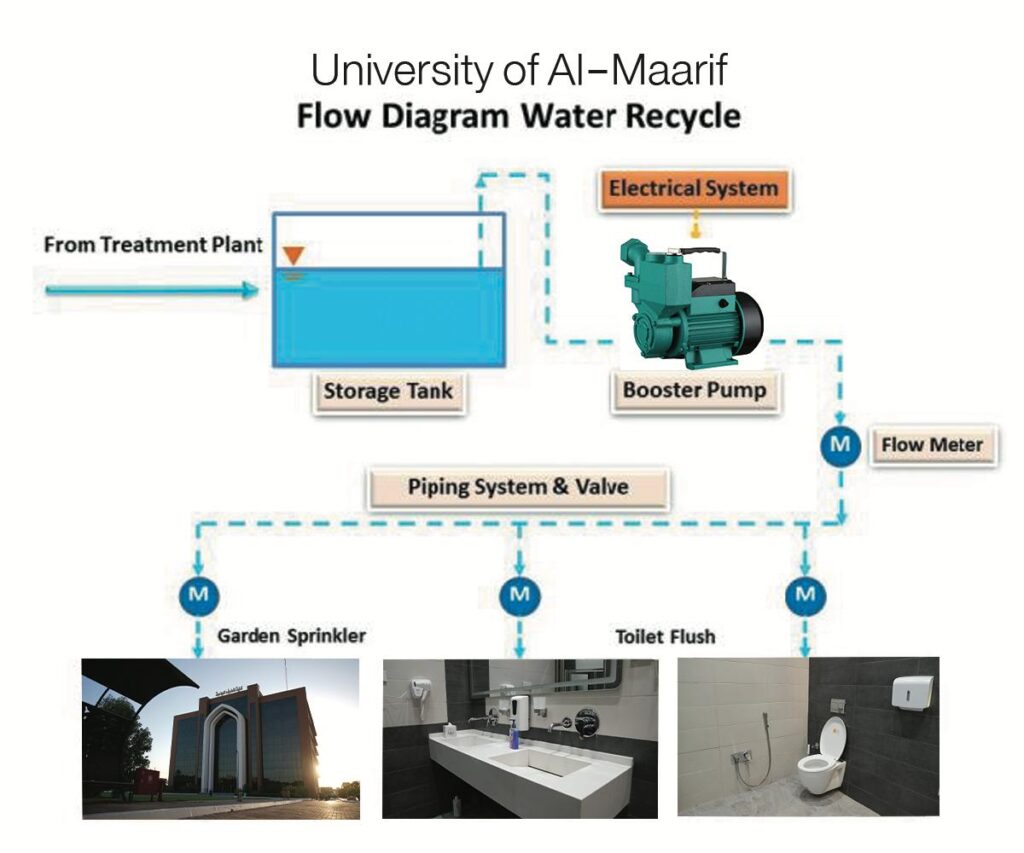
This advanced treatment stage enables the university to safely reuse treated water for irrigation of green spaces, cooling systems, and cleaning operations, thereby reducing demand for fresh municipal water.
3. Monitoring and Quality Assurance
Ensuring consistent water quality is a cornerstone of UOA’s wastewater management policy. The General Chemistry Laboratory, in collaboration with the Engineering Unit, conducts regular testing at two key water outlets:
- The main water source, which represents the input from the national water grid.
- The treated water outlet, representing the final effluent after treatment.
These tests are performed bi-weekly for the primary sources and weekly for treated outputs. The laboratory performs comprehensive analysis of parameters such as:
- TDS (Total Dissolved Solids)
- EC (Electrical Conductivity)
- SO₃ (Sulfite Concentration)
- Cl⁻ (Chloride Ions)
- Mg and Ca (Hardness Indicators)
- TH (Total Hardness)
Results are logged, verified, and stored within the university’s Environmental Monitoring Database, ensuring transparency, traceability, and continuous improvement. If any parameter exceeds regulatory thresholds, immediate corrective measures are implemented, including additional filtration or temporary system suspension.
4. Reuse and Recycling of Treated Wastewater
A key feature of the University of Al-Maarif’s sustainability agenda is its commitment to water reuse and resource recovery. Treated wastewater is considered a vital component of the campus’s green infrastructure and is reused for multiple non-potable purposes, such as:
- Irrigation of Landscaped Areas – The university maintains extensive green zones, gardens, and tree-lined pathways. Reclaimed water is used for irrigation, reducing freshwater demand by an estimated 40 % annually.
- Cooling and Air-Conditioning Systems – The Engineering Unit integrates treated water into selected cooling towers, particularly for non-contact applications, to minimize energy and resource use.
- Campus Cleaning and Dust Control – Outdoor cleaning and dust-suppression systems rely on treated water, maintaining hygiene while conserving municipal resources.
- Laboratory and Technical Applications – In controlled environments, filtered water is reused in preliminary rinsing and non-critical processes, ensuring maximum utility while upholding safety.
This closed-loop reuse strategy demonstrates UOA’s innovative approach to circular resource management, reducing environmental footprint while strengthening resilience against water scarcity—an increasingly pressing challenge in Iraq’s arid climate.
5. Governance, Compliance, and Environmental Policy
The University of Al-Maarif Environmental Policy outlines the governance structure for wastewater management and environmental compliance. Oversight responsibilities are distributed as follows:
- The Dean of the College of Engineering supervises technical operations and infrastructure maintenance.
- The Sustainability and Global Ranking Center (SGRC) oversees data documentation, reporting, and compliance with UI GreenMetric, Times Higher Education Impact Rankings, and national sustainability frameworks.
- The Environmental Health and Safety Committee ensures regulatory compliance with Iraqi environmental laws and international water safety standards.
This cross-departmental structure ensures that wastewater treatment is not a stand-alone activity but an integrated part of the university’s operational and sustainability ecosystem.
To maintain transparency and accountability, the university conducts annual audits and third-party water-quality verification, ensuring independent validation of results. Reports are shared with the Ministry of Environment and the Ministry of Higher Education and Scientific Research as part of UOA’s sustainability reporting process.
6. Capacity Building, Research, and Innovation
The University of Al-Maarif integrates wastewater treatment into its research, teaching, and capacity-building agenda. Engineering and Environmental Science students actively engage in applied research projects focusing on:
- Optimization of biological treatment efficiency through microbial culture studies.
- Development of low-cost filtration materials using locally available natural resources.
- Digital monitoring systems for real-time water-quality data collection and analysis.
- Renewable-energy-powered treatment units, such as solar-assisted aeration and pumping.
Laboratories serve as living learning platforms where students participate in data collection, laboratory testing, and environmental modeling. This approach combines academic learning with practical sustainability application, strengthening technical capacity and environmental literacy.
UOA also collaborates with regional universities and international organizations to develop joint research proposals focusing on water conservation, treatment efficiency, and climate-resilient infrastructure.
7. Digitalization and ICT Integration
In line with global trends in smart environmental management, the university employs Information and Communication Technology (ICT) to enhance wastewater management operations.
- Digital Sensors and IoT Integration: Real-time monitoring devices measure flow rate, pH, temperature, and chemical concentrations at key stages of the treatment process.
- Data Analytics Dashboards: Centralized systems aggregate laboratory results and sensor readings to enable predictive maintenance and performance optimization.
- GIS-based Mapping: The Engineering Unit uses geographic mapping to monitor wastewater pipeline networks and identify potential leakage or inefficiencies.
- Mobile Reporting Applications: Staff can report anomalies instantly through digital forms, triggering maintenance responses and data logging.
This digital transformation ensures efficient resource use, rapid response to potential environmental risks, and accurate performance evaluation aligned with SDG 9 (Industry, Innovation, and Infrastructure).
8. Education, Awareness, and Community Engagement
UOA’s wastewater management program extends beyond technical operations to include education and public awareness initiatives. The university integrates topics of water conservation, pollution prevention, and wastewater recycling into:
- General education courses on environmental sustainability.
- Awareness campaigns targeting students and staff through posters, workshops, and social media.
- Community seminars delivered in collaboration with local schools and municipalities.
These activities encourage behavioral change, promote environmental responsibility, and highlight the importance of protecting water resources.
Furthermore, student volunteers from the Environmental Club and Engineering Society participate in “Clean Water Weeks,” conducting outreach programs that demonstrate wastewater reuse practices and environmental testing methods to the wider community.
9. Alignment with Sustainable Development Goals (SDGs)
UOA’s wastewater treatment initiatives directly and indirectly support multiple UN Sustainable Development Goals, as summarized below:
| SDG | Contribution |
|---|---|
| SDG 6 – Clean Water and Sanitation | Advanced wastewater treatment, safe reuse, and quality monitoring systems. |
| SDG 7 – Affordable and Clean Energy | Integration of solar-powered pumps and low-energy aeration systems. |
| SDG 9 – Industry, Innovation, and Infrastructure | Application of smart sensors, IoT, and research in treatment innovation. |
| SDG 11 – Sustainable Cities and Communities | Reducing environmental impact and improving urban water resilience. |
| SDG 12 – Responsible Consumption and Production | Wastewater recycling and sustainable resource management. |
| SDG 13 – Climate Action | Reducing emissions associated with water treatment and transport. |
| SDG 17 – Partnerships for the Goals | Collaboration with ministries, universities, and international bodies for sustainability reporting and research. |
10. Future Plans and Strategic Expansion
The University of Al-Maarif continues to enhance its wastewater management capacity through forward-looking projects, including:
- Expansion of On-Campus Treatment Facilities: Increasing capacity to accommodate future student growth and facility expansion.
- Integration of Renewable Energy: Installation of photovoltaic systems to power pumps and aerators.
- Rainwater Harvesting Integration: Combining stormwater collection with greywater reuse systems to improve efficiency.
- Automated Data Systems: Deploying machine-learning-based predictive models for maintenance and performance forecasting.
- Green Infrastructure Expansion: Using treated water to support green roofs, vertical gardens, and sustainable landscaping.
These developments demonstrate the university’s proactive stance in adapting to environmental challenges, mitigating water scarcity, and promoting sustainable innovation in higher education.
Conclusion
The University of Al-Maarif has established a robust and forward-looking wastewater treatment and management system that serves as a model of sustainable infrastructure within Iraq’s higher education sector. By integrating engineering excellence, scientific research, digital innovation, and community engagement, the university ensures that every drop of water is managed responsibly—from source to reuse.
This comprehensive system not only safeguards public health and the environment but also advances the university’s broader mission of contributing to the United Nations Sustainable Development Goals, particularly SDG 6 (Clean Water and Sanitation) and SDG 13 (Climate Action).
Through continuous improvement, monitoring, and education, UOA demonstrates that responsible wastewater management is both an environmental obligation and a strategic opportunity to foster sustainability, innovation, and resilience for future generations.