
Introduction
The University of Al-Maarif (UOA) recognizes that water is not only an environmental necessity but a cornerstone of public health, agriculture, and social stability in Iraq’s arid climate. Located in Al-Anbar Governorate, where groundwater resources are limited and seasonal variability is increasing, the university has developed a comprehensive policy and practice framework for sustainable water extraction.
This program aims to ensure that all forms of water withdrawal—from wells, municipal sources, and treated systems—are managed in a manner that protects aquifers, minimizes waste, and supports long-term ecosystem resilience. The initiative forms part of UOA’s institutional sustainability strategy and contributes directly to UN SDG 6 (Targets 6.3–6.6), as well as to SDG 12 (Responsible Consumption and Production) and SDG 13 (Climate Action).
Through innovation, monitoring, and partnerships, UOA strives to demonstrate that responsible water extraction can coexist with campus expansion, research, and community engagement.
1. Policy Framework and Governance
1.1 Water Resource Sustainability Policy (WRSP-2024)
UOA’s Water Resource Sustainability Policy, adopted by the University Council in 2024, provides the foundation for all extraction-related activities. The policy establishes guiding principles for water use, prioritizing:
- Conservation before consumption.
- Reuse before withdrawal.
- Scientific monitoring of groundwater levels and quality.
- Integration of education, research, and community outreach.
1.2 Institutional Structure
Oversight is managed by the Water and Environmental Management Committee (WEMC), comprising representatives from:
- the Sustainability and Global Ranking Unit (SGRU),
- the Engineering and Facilities Department,
- the Environmental Health and Safety Office, and
- academic experts from the College of Engineering and College of Allied Medical Sciences.
The committee meets quarterly to review data, approve extraction schedules, and evaluate compliance.
2. Sources of Water Extraction
2.1 Groundwater Wells
UOA operates two monitored deep-well systems situated on campus periphery zones. Both wells draw from the upper Al-Anbar aquifer and are fitted with digital flow meters and submersible pumps operating at variable frequencies to minimize over-extraction.
The wells serve primarily for:
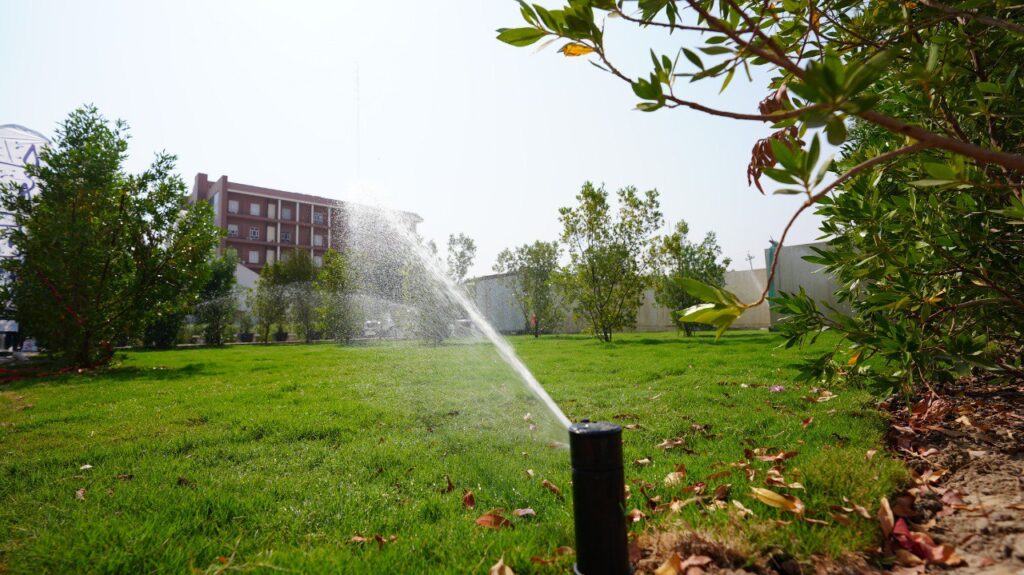
- Landscape irrigation,
- Non-potable cleaning applications, and
- Backup water supply during municipal interruptions.
Extraction rates are limited to < 20 % of natural recharge, based on annual hydro-geological studies conducted in cooperation with the Al-Anbar Water Directorate.
2.2 Municipal Water Supply
Potable water is sourced from the municipal network, regulated under local authority guidelines. The university’s engineering unit coordinates with city operators to ensure fair distribution and minimize demand during drought periods.
2.3 Reused and Harvested Water
Complementing extraction, UOA maximizes treated greywater and rainwater through a closed-loop reuse system that supplies approximately 45 % of the campus’s total irrigation needs. This approach significantly reduces the demand for fresh extraction.
3. Hydrological Research and Monitoring
3.1 Aquifer Studies
Each year, UOA’s environmental engineering faculty performs hydro-geological mapping using bore-hole loggers and piezometers. These studies track groundwater levels, salinity, and recharge rates to guide extraction planning.
3.2 Digital Monitoring Network
Real-time sensors installed in both wells transmit data on flow rate, static water level, pumping duration, and electrical conductivity to a centralized Water Dashboard accessible to administrators and students. Alerts are automatically triggered if withdrawals exceed preset thresholds.
3.3 Water Quality Assurance
Monthly laboratory analyses are conducted for parameters such as pH, turbidity, total dissolved solids (TDS), nitrates, sulfates, and microbial content. Results are benchmarked against WHO and Iraqi environmental standards.
Findings are documented in the Annual Water Sustainability Report, ensuring transparency and public accountability.
4. Sustainable Extraction Techniques
4.1 Controlled Pumping Schedules
UOA follows an alternating well-operation model, ensuring aquifer rest periods. Pumping is restricted to off-peak hours (evening and early morning) to reduce energy load and minimize evaporation.
4.2 Variable-Speed Pump Systems
Energy-efficient pumps with variable-frequency drives automatically adjust flow to demand, preventing pressure surges and excessive withdrawal.
4.3 Leak Detection and Maintenance
The Facilities Department employs ultrasonic flow analysis to detect leaks in underground pipes. A predictive-maintenance schedule ensures pump calibration and line repairs, reducing water loss by an estimated 8 % annually.
4.4 Smart Irrigation Integration
Extraction rates are directly tied to smart irrigation sensors that determine real-time soil moisture. This precision approach eliminates overwatering and prevents unnecessary extraction.
5. Environmental Protection and Aquifer Conservation
5.1 Recharge Area Preservation
UOA collaborates with local authorities to protect aquifer recharge zones near campus by restricting construction and chemical runoff. Designated green belts act as natural filtration barriers.
5.2 Pollution Prevention Measures
- Wastewater is fully treated before discharge or reuse.
- No hazardous waste is permitted near extraction points.
- Regular soil and groundwater sampling ensure contamination prevention.
5.3 Seasonal Extraction Adjustments
During low-recharge months (June–September), extraction is reduced by 25 %, compensated by stored and reused water. This adaptive management maintains long-term groundwater stability.
6. Infrastructure and Technology
6.1 Groundwater Wells Infrastructure
Each well is equipped with:
- Stainless-steel submersible pumps (capacity ≈ 60 m³/hour),
- Automated valves and pressure regulators,
- Flow and conductivity sensors, and
- Real-time monitoring connectivity.
6.2 Water Storage and Retention
Two 250-m³ underground reservoirs store extracted water for controlled distribution, ensuring a steady supply without continuous pumping.
6.3 Renewable Energy Integration
Solar panels on administrative buildings power extraction pumps during daylight hours, saving ≈ 30 MWh annually and reducing operational costs.
6.4 Emergency Contingency Plan
In drought or contamination scenarios, UOA maintains an Emergency Water Supply Plan to restrict non-essential use, activate stored reserves, and coordinate with municipal networks.
7. Data, Measurement, and Evaluation
| Indicator | 2024 Baseline | 2025 Target |
|---|---|---|
| Total water extracted (m³/year) | 78 000 | ≤ 70 000 |
| % from groundwater | 35 % | ≤ 30 % |
| % replaced by reused water | 45 % | ≥ 50 % |
| Reduction in extraction vs. 2020 baseline | 23 % | 30 % |
| Energy used for pumping (MWh/year) | 52 | ≤ 40 |
Data are reviewed quarterly by the WEMC to evaluate efficiency and compliance with national sustainability benchmarks.
8. Academic and Research Integration
8.1 Curriculum Development
Courses in Environmental Engineering, Hydrology, and Sustainable Infrastructure include modules on groundwater modeling and responsible extraction. Students participate in field measurements and data interpretation.
8.2 Student Research
Undergraduate and graduate projects analyze topics such as:
- Modeling aquifer recharge under climate change scenarios,
- Cost–benefit analysis of greywater systems,
- Comparative energy use in extraction technologies.
8.3 Research Collaborations
UOA collaborates with University of Anbar, Ministry of Water Resources, and UNDP Iraq on research grants studying hydrological resilience and water governance.
9. Community Outreach and Capacity Building
9.1 Training for Farmers and Technicians
Workshops titled “Water Extraction and Sustainable Irrigation in Drylands” train local farmers on groundwater management and well maintenance. Over 250 participants have completed certification courses.
9.2 Public Lectures and Awareness Campaigns
Each March, coinciding with World Water Day, the university organizes open lectures and media campaigns under “Our Water, Our Responsibility”. Topics include aquifer depletion, water ethics, and conservation practices.
9.3 School Engagement
Environmental science students conduct educational visits to local schools, introducing students to water conservation techniques and the importance of protecting wells from pollution.
10. Partnerships and Collaboration
UOA’s sustainable extraction efforts thrive through cooperation with local and international partners:
| Partner Organization | Area of Collaboration |
|---|---|
| Ministry of Water Resources | Hydrological data sharing, extraction licensing |
| Anbar Water Directorate | Aquifer monitoring and community training |
| UNDP Iraq | Technical and funding support for smart monitoring |
| World Health Organization (WHO) | Water-quality testing and public health standards |
| Private Engineering Firms | Equipment maintenance and renewable-energy integration |
These partnerships ensure that UOA’s water practices align with best global standards.
11. Socio-Economic and Environmental Impact
11.1 Environmental Impact
- Reduced extraction pressure on the Al-Anbar aquifer.
- Improved soil moisture and vegetation coverage through efficient irrigation.
- 15 % decrease in university carbon footprint from pumping operations.
11.2 Economic Impact
- Lowered municipal water expenditure by ≈ 35 %.
- Reduced energy costs due to renewable integration.
- Enhanced research funding and grants in environmental technology.
11.3 Social Impact
- Increased local community awareness of sustainable water management.
- Strengthened reputation of UOA as a model for responsible higher-education practices.
12. Innovation and Future Development
12.1 AI-Assisted Water Management
UOA is developing an AI-driven decision-support system to predict water-demand fluctuations and recommend optimized extraction schedules.
12.2 Groundwater Recharge Experiments
Pilot projects aim to recharge depleted aquifers through rainwater infiltration wells combined with bio-filters that enhance percolation and quality.
12.3 Regional Water Security Center
Plans are underway to establish a Center for Water Security and Sustainable Extraction, serving as a regional hub for training, research, and policy dialogue.
12.4 Water Neutrality by 2030
The university’s long-term goal is to achieve “water neutrality”—balancing extraction with reuse and recharge to ensure no net loss to local ecosystems.
13. Monitoring Compliance and Continuous Improvement
13.1 Internal Auditing
An annual Sustainability Audit reviews extraction records, water bills, and sensor data. Audit results are included in the UOA Annual Sustainability and SDG Report.
13.2 Feedback Mechanism
Departments submit quarterly reports on water use; anomalies trigger technical inspections.
13.3 Continuous Training
All facilities staff undergo periodic refresher courses on pump management, leak detection, and emergency response procedures.
14. Challenges and Mitigation
| Challenge | Mitigation Strategy |
|---|---|
| Seasonal droughts and reduced recharge | Expansion of greywater reuse and rain harvesting |
| Energy cost fluctuations | Integration of additional solar capacity |
| Public misperception about groundwater safety | Transparent communication and open data dashboards |
| Salinity increase in lower aquifer layers | Routine water-mixing and filtration before use |
Through these adaptive strategies, UOA ensures resilience amid climate uncertainty.
15. Quantitative Summary (2024)
| Category | Indicator | Result |
|---|---|---|
| Extraction | Groundwater withdrawal (m³/year) | 27 000 |
| Municipal water consumption (m³/year) | 51 000 | |
| % Reduction since 2020 | 23 % | |
| Reuse & Recycling | Treated water reused (m³/year) | 24 500 |
| Rainwater captured (m³/year) | 2 800 | |
| Efficiency | Energy for pumping (MWh/year) | 40 |
| Water saved vs baseline (m³/year) | 11 000 | |
| Community Impact | Farmers trained | 250 |
| Awareness participants | 4 000 |
16. Alignment with Sustainable Development Goals
| SDG | Contribution of UOA Sustainable Water Extraction Program |
|---|---|
| SDG 6 – Clean Water and Sanitation | Efficient groundwater management, reuse, and water-quality protection. |
| SDG 11 – Sustainable Cities and Communities | Resilient infrastructure and resource efficiency for local communities. |
| SDG 12 – Responsible Consumption and Production | Reduction of waste and integration of circular water systems. |
| SDG 13 – Climate Action | Energy-efficient extraction, renewable energy integration, and adaptation planning. |
| SDG 17 – Partnerships for the Goals | Collaboration with government and international organizations. |
Conclusion
The University of Al-Maarif (UOA) demonstrates that responsible resource management can be both scientifically rigorous and socially impactful. Its Sustainable Water Extraction Program stands as a national benchmark for balancing growth with ecological responsibility.
Through continuous innovation—digital monitoring, reuse integration, research, and partnerships—UOA safeguards water for present and future generations, turning sustainability into daily practice and education into action.