SDG-Focused Courses (Indicator 17.4.2)
Dedicated Full-Degree and Elective Courses Addressing Sustainability and the SDGs
1. Introduction
The University of Al Maarif (UOA), located in the city of Anbar, Iraq, has made a transformative commitment to advancing the United Nations Sustainable Development Goals (SDGs) through its educational mission. In alignment with SDG 17.4.2, which calls for the establishment of dedicated degree or elective courses focusing on sustainability and the SDGs, UOA has strategically restructured its academic programs to embed sustainability as a cross-cutting theme across all disciplines.
The university recognizes that addressing Iraq’s pressing socio-economic and environmental challenges requires an education system that not only imparts knowledge but also cultivates critical thinkers, problem-solvers, and ethical leaders equipped to contribute to national reconstruction and sustainable growth. By offering full-degree programs and elective courses centered on sustainability and SDG education, the University of Al Maarif demonstrates its leadership in transforming higher education into a driver of sustainable development, peace, and resilience in post-conflict Iraq.
2. Strategic Vision and Institutional Alignment
The integration of SDG-focused courses at UOA is part of its broader vision to align academic programs with the 2030 Agenda for Sustainable Development and Iraq’s National Development Plan (2021–2025).
The university’s sustainability strategy emphasizes four key objectives:
- Embedding SDG principles in curricula across faculties and disciplines.
- Developing specialized academic programs in sustainability, environmental science, and social innovation.
- Training faculty to deliver sustainability-oriented education through innovative pedagogies.
- Empowering students to apply sustainability concepts through research, internships, and community-based projects.
Through these objectives, UOA ensures that its SDG-focused courses are not only theoretical but also practical, fostering competencies that contribute directly to local and global sustainability challenges.
3. SDG-Oriented Academic Framework
To implement SDG 17.4.2 effectively, the University of Al Maarif developed an SDG Curriculum Framework (2023–2030)—a roadmap ensuring that sustainability themes are embedded throughout academic programs, including undergraduate and postgraduate degrees.
The framework rests on four pillars:
- Dedicated Programs: Full-degree programs focused on environmental and sustainable development fields.
- SDG Elective Courses: University-wide electives that expose all students to sustainability concepts regardless of their major.
- Interdisciplinary Integration: Inclusion of SDG topics into core courses across faculties.
- Community and Research Application: Linking coursework with real-world SDG implementation projects in Anbar and across Iraq.
This structure ensures that every student, from engineering to medicine and from law to business, engages with at least one SDG-focused learning experience during their academic journey.
4. Dedicated Full-Degree Programs Addressing Sustainability and the SDGs
The University of Al Maarif offers several degree programs explicitly designed to advance sustainable development education and practice. These programs integrate sustainability theory, fieldwork, and applied research components that address local and global challenges.
4.1 Bachelor of Environmental and Sustainable Development Studies
This pioneering undergraduate program, launched in 2023, provides an interdisciplinary foundation in environmental science, policy, and sustainable development.
Core courses include:
- Introduction to Sustainable Development
- Climate Change and Environmental Policy in Iraq
- Sustainable Agriculture and Food Security
- Renewable Energy Systems and Green Technologies
- Environmental Ethics and Law
- SDG Impact Assessment and Project Design
Learning outcomes:
Graduates develop the knowledge and skills necessary to design and implement sustainability projects, influence policy, and work in environmental NGOs, government ministries, and development agencies.
4.2 Master of Sustainability and Innovation
This postgraduate program, launched in partnership with the UNDP Iraq Office and regional universities, focuses on innovation-driven solutions for sustainable development challenges.
Key modules include:
- Innovation for Sustainable Development
- Circular Economy and Waste Management
- Social Entrepreneurship and the SDGs
- Sustainability Analytics and Data for Development
- Governance for Green Transitions
Capstone component:
Students work in teams to design sustainability innovations addressing real issues in the Anbar region — such as water scarcity, post-conflict reconstruction, and community health.
4.3 Bachelor of Renewable Energy Engineering
The College of Engineering offers a specialized program addressing SDG 7 (Affordable and Clean Energy). Students learn to design, develop, and manage renewable energy systems adapted to Iraq’s climatic conditions.
Representative courses:
- Solar Photovoltaic Systems
- Wind Energy Design and Simulation
- Energy Efficiency and Smart Grids
- Environmental Impact of Energy Systems
- Energy Economics and Sustainable Policy
Graduates are trained to advance Iraq’s renewable energy transition and contribute to national energy independence.
4.4 Bachelor of Public Health and Community Well-being
Offered by the College of Medicine and Health Sciences, this program links SDG 3 (Good Health and Well-being) with SDG 6 and SDG 11. Students are trained in preventive healthcare, community engagement, and environmental health.
Core courses:
- Global Health and the SDGs
- Sustainable Water and Sanitation Systems
- Environmental Epidemiology
- Disaster Risk Reduction and Resilience
Through field placements, students engage with communities to improve health outcomes and promote sustainable lifestyles.
5. SDG-Related Elective Courses Across Disciplines
Recognizing that sustainability is relevant to every field, UOA offers cross-disciplinary elective courses accessible to all undergraduate students. These electives connect students’ areas of study to the broader SDG framework.
5.1 Examples of Elective Courses
| Course Title | SDGs Covered | Offered by | Description |
|---|---|---|---|
| Sustainability and the Future of Iraq | SDG 8, 9, 11, 16 | Faculty of Humanities | Examines Iraq’s sustainable reconstruction and governance through the SDG lens. |
| Ethics, Justice, and Global Citizenship | SDG 4, 5, 10, 16 | Faculty of Law | Explores equality, peacebuilding, and justice in the SDG context. |
| Digital Technologies for Sustainability | SDG 9, 12, 17 | Faculty of IT | Teaches students to use digital tools and data to monitor and advance SDG indicators. |
| Green Business and Responsible Finance | SDG 8, 9, 12 | College of Business | Focuses on sustainable business practices, social entrepreneurship, and ESG finance. |
| Climate Change Communication and Media Literacy | SDG 13, 15 | Faculty of Media | Develops communication strategies for environmental awareness and behavioral change. |
These courses are designed to foster critical thinking, systems awareness, and civic engagement — equipping students with the competencies needed to advance the SDGs in professional and personal contexts.
6. Interdisciplinary Integration of SDGs Across Faculties
Beyond dedicated programs and electives, UOA ensures that SDG perspectives are infused into existing disciplines. Each faculty has identified at least five SDGs most relevant to its teaching and research mission.
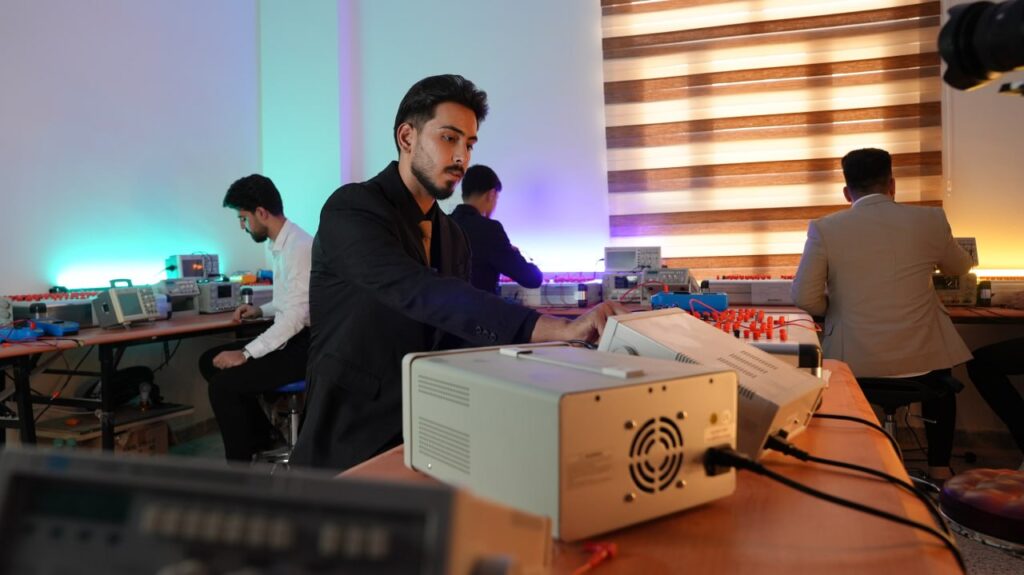
6.1 Faculty of Engineering
Focuses on:
- Renewable energy and energy efficiency (SDG 7)
- Sustainable infrastructure (SDG 9)
- Water resource management (SDG 6)
- Urban resilience (SDG 11)
- Innovation and technology for sustainability (SDG 17)
6.2 Faculty of Law and Political Science
Integrates:
- Peace, justice, and strong institutions (SDG 16)
- Gender equality (SDG 5)
- Governance and public policy for SDGs (SDG 17)
6.3 Faculty of Business and Economics
Aligns courses with:
- Sustainable finance (SDG 8)
- Responsible consumption and production (SDG 12)
- Corporate social responsibility (SDG 9)
- Green entrepreneurship (SDG 11)
6.4 Faculty of Medicine and Health Sciences
Focuses on:
- Health and well-being (SDG 3)
- Access to clean water and sanitation (SDG 6)
- Climate and environmental health (SDG 13)
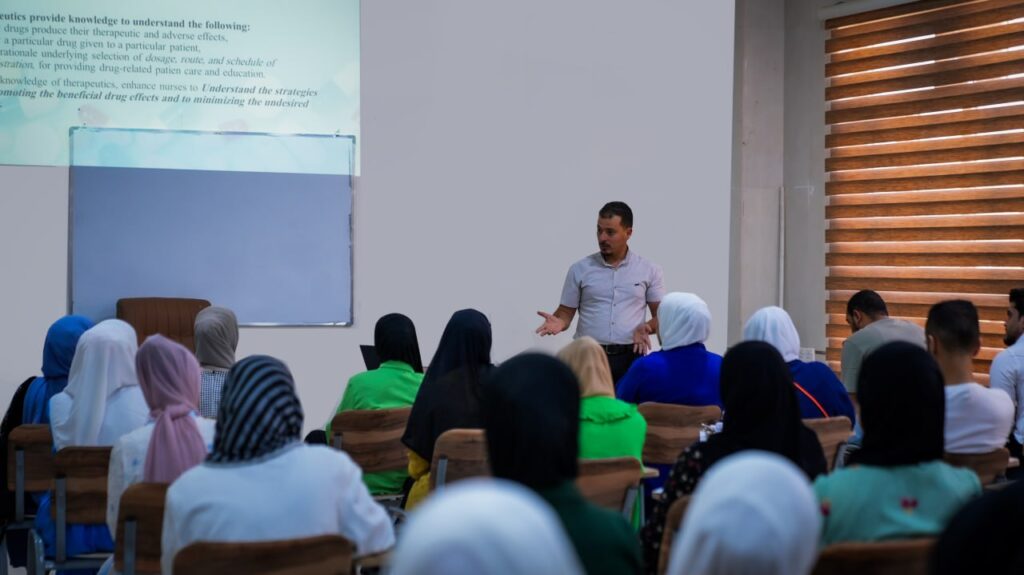
6.5 Faculty of Education and Humanities
Emphasizes:
- Quality education for sustainable societies (SDG 4)
- Human rights and social inclusion (SDG 10)
- Cultural heritage and peace education (SDG 16)
Through this holistic integration, sustainability becomes not an isolated subject but a core educational ethos permeating the entire academic experience.
7. Pedagogical Innovation in SDG-Focused Courses
To make SDG-focused courses transformative rather than traditional, UOA emphasizes experiential and problem-based learning (PBL) methods.
7.1 Active Learning
Students engage in sustainability challenges, case studies, and simulations reflecting Iraq’s real-world issues such as drought, migration, and urban recovery.
7.2 Research-Based Learning
Courses include applied research projects where students design SDG-aligned solutions — e.g., designing low-cost solar systems for rural areas or developing community recycling programs.
7.3 Service-Learning Components
Elective courses require students to participate in local development initiatives — for example, tree-planting drives, water conservation campaigns, and literacy workshops.
7.4 Interdisciplinary Collaboration
Joint projects bring together students from engineering, law, business, and medicine to co-create integrated SDG solutions — reflecting the interconnected nature of sustainable development.
8. Faculty Development and Capacity Building
The success of SDG-focused courses depends on faculty competency. The Center for Academic Development and Sustainability Education (CADSE) was established in 2022 to train educators in sustainability pedagogy.
Training Modules include:
- Teaching the SDGs: Curriculum Design and Assessment
- Interdisciplinary Sustainability Teaching
- ESD Competencies for Higher Education
- Digital Tools for SDG Monitoring
Over 150 faculty members have completed SDG-teaching certifications through workshops co-sponsored by UNESCO Iraq and the Arab Universities Association for Sustainable Development.
Faculty are also encouraged to incorporate the UN’s SDG Learning Objectives Framework (2017) into their lesson plans to ensure global alignment and measurable learning outcomes.
9. Research Integration and SDG Academic Networks
UOA encourages course-based research linked to sustainability themes. Undergraduate and postgraduate students engage in:
- SDG impact assessments of community projects
- Feasibility studies on renewable energy in Anbar
- Gender equality in education and employment
- Sustainable water management models for rural Iraq
The SDG Academic Network, established in 2023, connects UOA students and faculty with regional partners from universities in Jordan, Egypt, and Lebanon for joint SDG research and publication.
Through this network, course assignments often lead to co-authored research papers, demonstrating how SDG education translates into tangible academic outputs and policy insights.
10. Community Engagement Through SDG Courses
UOA’s SDG-focused courses integrate direct community collaboration:
- SDG Practicum: A capstone module requiring students to work with local NGOs, government offices, or private firms on real SDG projects.
- Sustainability in Action Workshops: Student groups develop micro-projects such as clean energy prototypes, waste reduction campaigns, and community health awareness.
- “Adopt a Goal” Program: Each academic department selects one SDG annually and organizes activities, seminars, and projects around that goal — encouraging ownership and collective action.
These initiatives ensure that SDG-focused education produces community impact, not just classroom theory.
11. Assessment and Continuous Improvement
Each SDG-focused course undergoes annual curriculum review using the UOA SDG Course Evaluation Rubric, which measures:
- SDG coverage and relevance
- Interdisciplinarity
- Student engagement and experiential learning
- Societal impact outcomes
Feedback from students, faculty, and community partners informs continuous improvement. The university’s goal is to reach 100% SDG integration across all degree programs by 2030.
12. Challenges and Future Directions
12.1 Challenges
- Limited access to Arabic-language SDG resources.
- Need for enhanced faculty expertise in environmental economics and green technology.
- Budget constraints for laboratory upgrades and field research.
12.2 Strategic Next Steps
- Launch of Ph.D. in Sustainable Development and Policy (2026).
- Creation of the “Sustainability Academy” offering micro-credentials in SDG leadership.
- Expansion of online SDG courses for international collaboration.
- Establishment of an SDG Learning Repository featuring open-access teaching materials in Arabic.
- Integration of SDG metrics into student performance evaluation.
13. Impact and Achievements
Since the launch of SDG-focused courses:
- Over 3,200 students have enrolled in sustainability-related modules.
- Six degree programs include SDG-specific learning outcomes.
- Four new interdisciplinary programs were created (2023–2025).
- UOA ranked among the Top 10 Iraqi universities in the UN SDG Impact Ranking (Education Category) for 2024.
Graduates report higher employability in NGOs, governmental departments, and international organizations focusing on reconstruction, environment, and development — proving that SDG education drives both civic and economic growth.
14. Conclusion
The University of Al Maarif has positioned itself as a national leader in SDG-based education through its extensive network of dedicated courses, innovative pedagogy, and real-world engagement. By developing both full-degree and elective programs focused on sustainability, the university is nurturing a generation of professionals who are not only technically skilled but also ethically driven to advance Iraq’s recovery and long-term sustainable development.
Through SDG-focused education, UOA transforms knowledge into action — turning classrooms into catalysts for social progress, environmental preservation, and global collaboration. As Iraq rebuilds and redefines its future, the University of Al Maarif stands as a model of how higher education can embody the spirit of the 2030 Agenda: “Leave no one behind.”