Introduction
The University of Al-Maarif (UOA) recognizes the critical importance of addressing water-related challenges in Iraq and the broader Middle East region, where water scarcity, pollution, climate change, and infrastructure limitations continue to place significant stress on communities, agriculture, and public health. As part of its strategic alignment with the United Nations Sustainable Development Goals (SDG 6: Clean Water and Sanitation) and Iraq’s national development priorities, UOA has established an expanding research portfolio focused on water resource management, water quality monitoring, wastewater treatment, sustainable irrigation systems, pollution reduction, and community water awareness.
Research on water at UOA is conducted collaboratively across multiple faculties, including the Faculty of Medical Devices Engineering, Faculty of Pharmacy, Faculty of Science, Faculty of Education, and the Sustainability and Environmental Research Unit, in cooperation with external stakeholders such as municipal authorities, water laboratories, and community organizations. The university approaches water research as both a scientific endeavor and a public responsibility, aiming to ensure that findings contribute not only to knowledge production but also to local problem-solving, environmental resilience, and community well-being.
This institutional commitment supports several related national and global priorities:
| Goal | Description | UOA Contribution |
|---|---|---|
| SDG 6 | Clean Water and Sanitation | Research on water quality, access, pollution reduction, and water-efficient technologies |
| SDG 3 | Good Health and Well-being | Ensuring safe drinking water and reducing waterborne disease risk |
| SDG 11 | Sustainable Cities and Communities | Supporting environmentally resilient community infrastructure |
| SDG 13 | Climate Action | Research on drought mitigation and water adaptation strategies |
| SDG 17 | Partnerships for the Goals | Collaboration with government, academia, and civil society |
Through integrated research, teaching, training, and community-focused activities, the University of Al-Maarif plays a growing role in fostering sustainable and equitable access to water resources, ensuring that communities are better equipped to face environmental challenges and water-related threats.
Institutional Framework Supporting Water Research
1. Scientific Research Development Policy
UOA’s Deanship of Scientific Research issues targeted calls for proposals supporting:
Water quality analysis
Environmental monitoring
Water system modeling and simulation
Sustainable water use in agriculture and campus operations
2. Interdisciplinary Collaboration
Water-related research teams include:
Engineers (water system design and modeling)
Public health and environmental specialists
Pharmacists analyzing microbial contamination
Educators conducting community awareness programs
3. Research Facilities
Relevant laboratories include:
Chemical and Environmental Analysis Lab
Water Microbiology and Pathogen Detection Lab
Biomedical Instrumentation and Sensor Development Lab
These laboratories support high-accuracy experimentation and field research.
Key Research Themes and Contributions
UOA’s water research agenda spans several strategic domains. The most significant research themes include:
A. Water Quality Monitoring and Public Health Protection
A major portion of UOA’s research focuses on evaluating water quality in households, schools, rural areas, and municipal networks. Studies conducted by researchers investigate:
Microbial contamination (E. coli, coliform bacteria, and waterborne pathogens)
Chemical and heavy metal pollutants (lead, chromium, arsenic, nitrate)
Water acidity and mineralization rates
Risk factors for cholera outbreaks and intestinal infections
Findings are shared with:
Local health directorates
Municipal water treatment facilities
Community health campaigns
These studies contribute to reducing waterborne disease risks and improving surveillance systems in underserved communities.
B. Sustainable Water Resource Management in Arid Regions
Iraq faces severe water scarcity and declining river water flows. Research teams at UOA develop solutions such as:
Groundwater recharge and monitoring models
Drought risk assessments
Household and agricultural water-efficiency guidelines
Climate-adapted rainwater harvesting systems
Researchers analyze how climate change and urban population growth impact water availability, helping policymakers improve planning and conservation strategies.
C. Wastewater Treatment and Reuse Technologies
To reduce environmental pollution and conserve water, UOA researchers investigate cost-effective wastewater treatment systems, including:
Biofiltration systems
Membrane filtration and carbon adsorption
Eco-friendly chemical treatment alternatives
Reuse of treated water in agriculture and landscaping
These studies provide scalable solutions for rural communities, small businesses, and university campus operations.
D. Water Sensors and Smart Monitoring Devices
The Faculty of Medical Devices Engineering leads research on developing low-cost electronic water testing sensors that measure:
Water turbidity
pH levels
Conductivity
Microbial presence
These devices support early detection of contamination in rural and low-infrastructure settings where lab testing is limited.
E. Community-Based Water Education and Awareness
UOA emphasizes education as a tool for sustainable water behavior, conducting outreach in:
Schools
Local municipalities
Rural communities
Youth and women’s centers
Workshops cover:
Household water safety
Water conservation practices
Safe water storage and handling
Health risks of contaminated water
This aligns academic research with direct community benefit.
Campus Water Conservation and Living Labs
UOA’s campus acts as a model environment for sustainable water management, offering real data for scientific study. Initiatives include:
Water-efficient bathroom and irrigation fixtures
Sensor-based leak detection systems
Drought-resistant landscape planning
Water reuse in garden irrigation
Data from these systems is used in:
Graduation projects
Faculty research publications
Engineering and public health coursework
Faculty Publications and Research Output
UOA scholars publish research in:
Peer-reviewed national journals
Regional environmental science journals
International indexing platforms (Scopus / Web of Science)
Research topics include:
| Research Focus | Publication Output Examples |
|---|---|
| Microbial water contamination | Laboratory-based studies and community sampling reports |
| Wastewater reuse | Experiments on treatment efficiency and safety |
| Water scarcity management | Climate and hydrology modeling research |
| Smart sensors for water quality | Engineering research on detection devices |
The university encourages student participation, supporting early research skills development.
Partnerships and Collaboration
UOA collaborates with:
Local water authority (Directorate of Water and Environment)
Municipal waste treatment centers
Local schools and community health centers
NGOs working on environmental education
Academic partners through conferences and joint studies
These partnerships ensure research impact moves from theory into practice.
| # | Research Title | Link |
|---|---|---|
|
1 |
Groundwater level prediction using machine learning models: A comprehensive review |
|
|
2 |
Methods of Chemical Synthesis in the Synthesis of Nanomaterial and Nanoparticles by the Chemical Deposition Method: A Review |
|
|
3 |
Membrane distillation technology for molecular separation: A review on the fouling, wetting and transport phenomena |
|
|
4 |
Preparation of new bio-based chitosan/Fe2O3/NiFe2O4 as an efficient removal of methyl green from aqueous solution |
|
|
5 |
A comprehensive review on modelling the adsorption process for heavy metal removal from waste water using artificial neural network technique |
|
|
6 |
Effects of sulfur dioxide inhalation on human health: A review |
|
|
7 |
Anticancer Drug-Loading Capacity of Green Synthesized Porous Magnetic Iron Nanocarrier and Cytotoxic Effects Against Human Cancer Cell Line |
|
|
8 |
Engineering and surface modification of carbon quantum dots for cancer bioimaging |
|
|
9 |
Application of aluminum nitride nanotubes as a promising nanocarriers for anticancer drug 5-aminosalicylic acid in drug delivery system |
|
|
10 |
Development of ensemble machine learning approaches for designing fiber-reinforced polymer composite strain prediction model |
 |
|---|
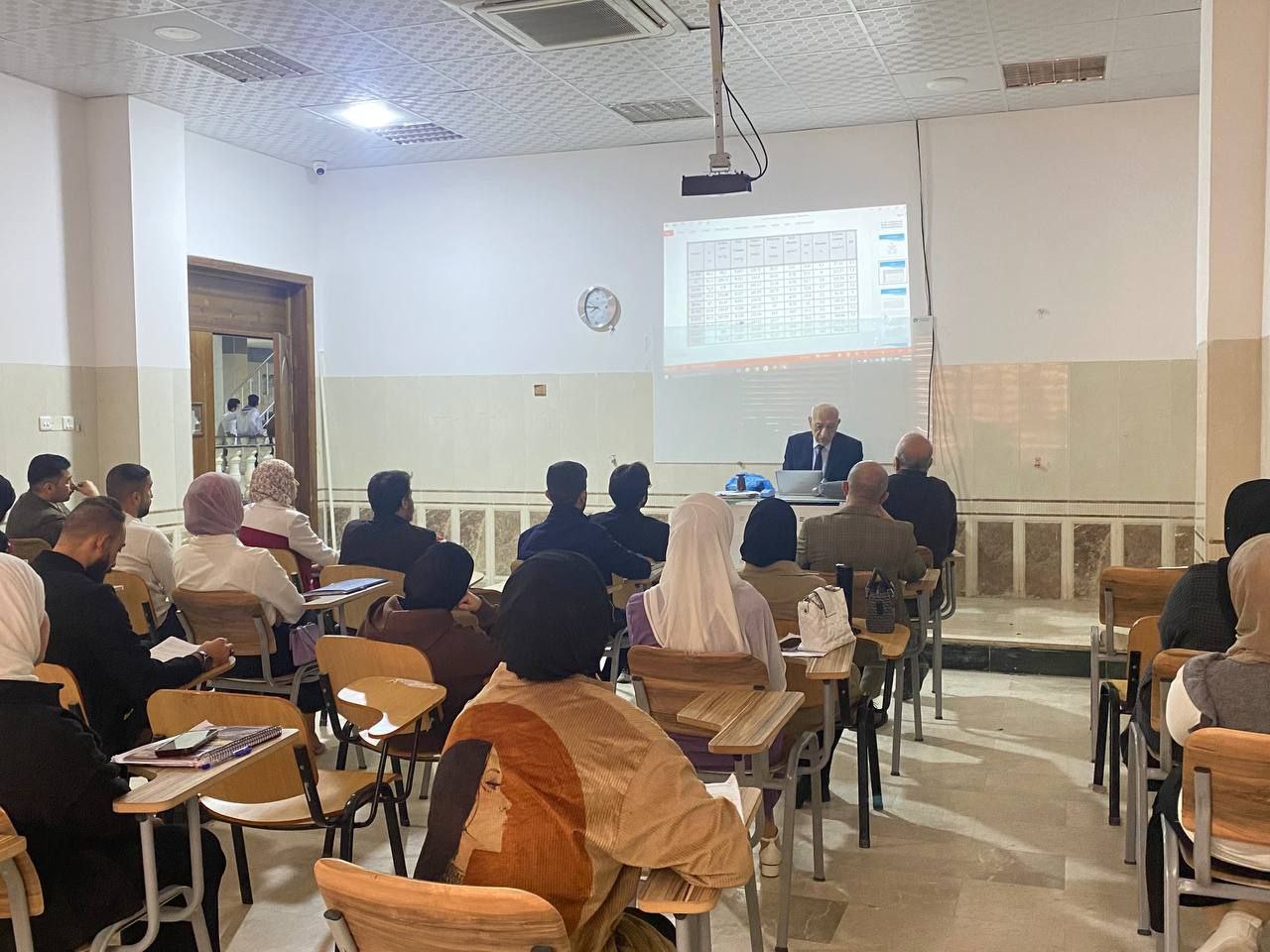
A Scientific Seminar Carbon Filters of Water |
On Thursday, 21st October 2023, the Department of Medical Laboratories Techniques at Al-Maarif University College organized a scientific seminar entitled “Reactivation of Carbon Filters of Water Purification Units,” presented by Dr. Ayad Abd Al-Razaq Mutar. The seminar focused on identifying and reactivating carbon filters used in drinking water purification systems. It highlighted the importance of these filters in improving water quality, reducing pollutants, and protecting public health. The discussion also emphasized the environmental benefits of proper water treatment methods and their role in maintaining a clean and safe ecosystem. The seminar contributed to raising scientific awareness among participants about sustainable water purification practices and environmental protection. |