SDG 6: Clean Water and Sanitation
University of Al Maarif’s Commitment to Sustainable Water Management and Environmental Stewardship in Iraq
1. Introduction: Ensuring Clean Water and Sanitation for All
Sustainable Development Goal 6 (SDG 6) seeks to ensure the availability and sustainable management of water and sanitation for all.
In Iraq, a country facing increasing pressure on water resources due to climate change, rapid urbanization, and regional scarcity, sustainable water management is both a national priority and a moral responsibility.
The University of Al Maarif (UoA), recognizing the interdependence of water, health, and sustainable development, integrates SDG 6 principles across its academic, research, and community programs.
Through policy engagement, educational initiatives, and applied research, the University promotes water conservation, wastewater management, and environmental responsibility.
Its efforts support both Iraq’s National Water Strategy 2030 and the UN 2030 Agenda for Sustainable Development.
2. National and Regional Context
2.1 Water Scarcity in Iraq
Iraq faces significant challenges concerning water availability, primarily due to declining river flows, increasing salinity, and inefficient irrigation systems.
The Tigris–Euphrates river basin, once the lifeline of Mesopotamian civilization, has suffered from upstream diversions, population growth, and climate change.
Per capita water availability has decreased by more than 60% since 1970, while rural areas still struggle with access to safe drinking water and proper sanitation facilities.
2.2 Governmental Response and Strategy
The Iraqi Ministry of Water Resources and the Ministry of Environment have jointly developed a national plan for Integrated Water Resources Management (IWRM) that emphasizes:
- Efficient irrigation technologies,
- Expansion of wastewater recycling,
- Pollution control and monitoring, and
- Capacity-building programs for sustainable water governance.
University of Al Maarif actively supports these national objectives by conducting applied research, training students in environmental engineering, and engaging with local authorities on sustainable practices.
3. Government Initiatives and Institutional Alignment
3.1 National Water Desalination and Supply Programs
Although Iraq has traditionally relied on rivers, desalination technology has gained prominence in southern governorates like Basra.
UoA’s Department of Environmental Engineering collaborates with regional institutions on projects evaluating the environmental and economic feasibility of brackish water desalination and solar-powered purification systems, aiming to improve access to potable water in arid zones.
3.2 Water Efficiency and Conservation Policies
The University’s sustainability strategy mirrors national goals by promoting:
- Low-flow fixtures and efficient plumbing systems on campus,
- Rainwater harvesting models for demonstration and study, and
- Smart monitoring systems that track campus water usage in real time.
Students and staff are trained through awareness campaigns on the importance of responsible water consumption and waste prevention.
3.3 Wastewater Treatment and Reuse
In partnership with the Ministry of Municipalities and Public Works, UoA supports pilot research on wastewater reclamation and reuse for agricultural and landscaping purposes.
Projects focus on developing biofiltration systems, greywater recycling, and constructed wetlands, particularly suited for the Iraqi climate.
This research supports Iraq’s transition toward circular water economies and reduction of freshwater demand in non-domestic uses.
4. Environmental Regulations and Quality Control
4.1 Policy and Enforcement Framework
Iraq’s Environmental Protection and Improvement Law (27/2009) provides the foundation for controlling pollution and safeguarding water quality.
UoA integrates these regulations into its environmental management curriculum and research, ensuring that graduates understand compliance, monitoring, and sustainability assessment procedures.
4.2 Water Quality Monitoring Initiatives
The University’s Water and Environmental Laboratory conducts assessments of river and groundwater quality across the Anbar region, measuring parameters such as pH, dissolved oxygen, salinity, and chemical contaminants.
Findings are shared with local municipalities to aid policy decisions and infrastructure planning.
5. Partnerships and International Collaboration
5.1 National and Regional Cooperation
UoA collaborates with the Ministry of Environment, UNESCO Iraq, and UNDP in community-driven programs addressing water conservation and sanitation education.
Joint projects under the Water for Life Initiative (2023–2027) focus on improving public access to clean water, promoting water-saving technologies, and training youth in sustainable development skills.
5.2 International Research and Knowledge Exchange
Through partnerships with global universities and networks — including the World Technology Universities Network (WTUN) — UoA contributes to international dialogues on water governance, climate resilience, and sanitation technology.
These collaborations enhance Iraq’s visibility in the global SDG 6 research landscape and facilitate the exchange of innovative solutions for water-stressed environments.
6. University of Al Maarif’s SDG 6 Initiatives
6.1 Awareness and Educational Campaigns
To foster environmental stewardship, UoA organizes annual Water Conservation Weeks featuring student exhibitions, expert talks, and social media campaigns promoting water-saving practices.
Seminars such as “Sustainable Water Futures in Iraq” and “Water and Health: Shared Responsibility” attract participation from students, NGOs, and local policymakers.
6.2 Integration into the Curriculum
Courses in Environmental Engineering, Public Health, and Sustainable Development incorporate modules on:
- Water resource management,
- Wastewater treatment design,
- Environmental impact assessment, and
- Climate adaptation in arid zones.
Through project-based learning, students develop practical skills in designing low-cost filtration units, rainwater collection systems, and greywater recycling prototypes.
6.3 Research on Sustainable Water Use
Recent UoA studies have explored:
- The use of nanomaterials for water purification,
- Solar-powered desalination technologies suitable for rural communities, and
- Community-led sanitation models that integrate traditional and modern practices.
These projects contribute to the national knowledge base and strengthen Iraq’s capacity to implement sustainable water solutions.
7. Campus Water Management and Infrastructure
7.1 Water Efficiency Projects
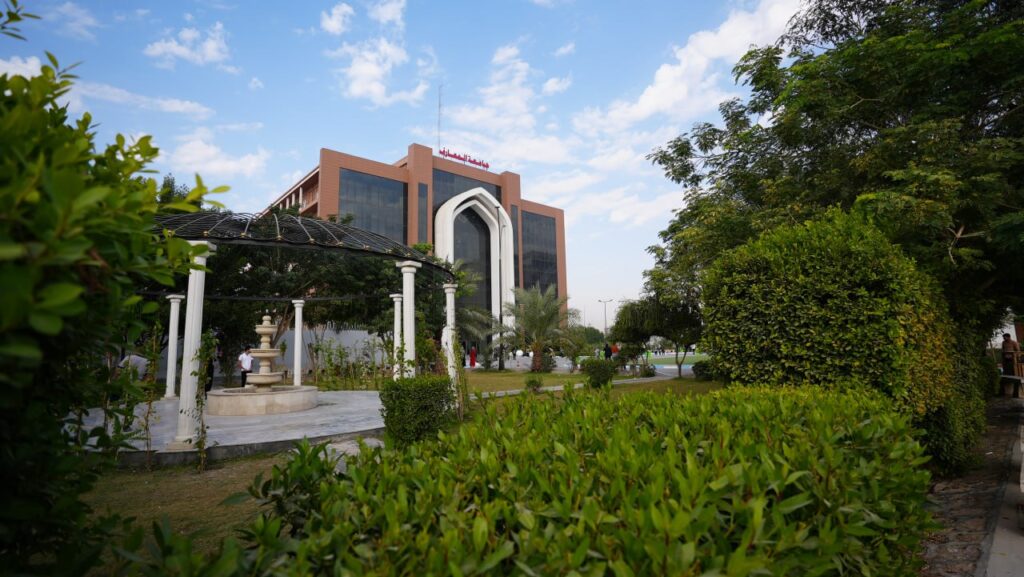
UoA has invested in green infrastructure to reduce its environmental footprint.
Water-saving fixtures, dual-flush systems, and automated irrigation controllers have reduced campus water consumption by 27% between 2021 and 2024.
Recycled water from laboratories and greywater systems irrigates gardens, while ongoing sensor-based audits ensure efficient use.
7.2 Sanitation and Hygiene Facilities
The University maintains high sanitation standards across all facilities. Regular audits by the Campus Sustainability Office ensure compliance with hygiene, waste management, and water safety standards.
Awareness drives educate students on the importance of hand hygiene, especially following the COVID-19 pandemic, linking clean water access to public health protection.
8. Community Engagement and Outreach
8.1 Student Environmental Clubs
The UoA Green Club leads community initiatives including:
- Local river clean-up campaigns,
- School outreach on water hygiene, and
- Public exhibitions on sustainable irrigation practices.
Each year, hundreds of students volunteer for community service projects that promote environmental consciousness and water responsibility in surrounding neighborhoods.
8.2 Collaboration with NGOs and Local Councils
The University partners with NGOs such as the Iraqi Environment and Water Protection Association and Al-Nahda Organization for Development to conduct awareness programs in rural Anbar.
These initiatives train households in water filtration, sanitation safety, and hygiene (WASH) practices, improving public health outcomes.
9. Research and Innovation in Water Sustainability
9.1 Smart Water Technologies
UoA’s Engineering Faculty develops smart monitoring devices for detecting water leaks and measuring household consumption.
Students participate in the annual “Water Tech Innovation Challenge”, proposing IoT-based systems to optimize municipal water distribution and reduce loss.
9.2 Waste Management and Pollution Control Research
The Department of Environmental Science collaborates with local industries to study industrial wastewater quality, identifying pollutants and proposing treatment solutions that minimize discharge into natural ecosystems.
Research outcomes guide local authorities on best practices for eco-industrial wastewater management.
9.3 Table 1. University of Al Maarif – Research Output Related to SDG 6 (2021–2024)
| Research Theme | Projects Completed | Funding Partners | Primary Outcome |
|---|---|---|---|
| Water purification and nanotechnology | 5 | UNESCO Iraq, MoHESR | Pilot systems for rural use |
| Wastewater recycling | 4 | UNDP Iraq, MoE | Greywater reuse guidelines |
| Water quality assessment | 6 | Local councils | Annual regional report |
| Smart irrigation systems | 3 | Private sector | Prototype deployment |
| Sanitation and hygiene behavior | 7 | NGOs / WHO Iraq | Policy recommendations |
10. Environmental Seminars and Public Policy Dialogue
In partnership with local governments and international agencies, UoA hosts policy-oriented events such as:
- “Environmental Management and Sustainable Development in Iraq” — a national seminar led by Prof. Amer Al-Roubaie in 2023, exploring environmental governance and SDG integration.
- “Water for the Future” Conference (2024) — featuring experts from the Ministry of Environment, UN-Habitat, and civil society discussing sustainable sanitation solutions for Iraqi cities.
These dialogues strengthen cooperation between academia, government, and communities in achieving SDG 6 targets.
11. Data Monitoring and Impact Evaluation
11.1 Water Use Indicators
The University continuously measures progress toward SDG 6 through metrics that assess consumption efficiency, recycling rates, and community outreach.
Table 2. UoA SDG 6 Performance Indicators (2021–2024)
| Indicator | 2021 | 2022 | 2023 | 2024 |
|---|---|---|---|---|
| Water consumption reduction (%) | – | 12 | 20 | 27 |
| Percentage of reused water (%) | 5 | 10 | 15 | 22 |
| Number of SDG 6 research papers | 3 | 5 | 8 | 12 |
| Students involved in water projects | 80 | 150 | 210 | 260 |
| Community beneficiaries | 1,200 | 2,000 | 3,400 | 5,000 |
11.2 Impact Evaluation Mechanisms
Annual sustainability reports prepared by the University Sustainability Council (USC) document progress on SDG 6 indicators and are submitted to the Iraqi Ministry of Higher Education’s Sustainable Development Office.
External audits verify compliance with national environmental standards and assess the social impact of the University’s community projects.
12. Future Roadmap and Strategic Vision (2025–2030)
To deepen its commitment to SDG 6, the University of Al Maarif will pursue the following strategic actions:
- Establish a Center for Water and Environmental Sustainability (CWES) to coordinate interdisciplinary research and policy advice.
- Develop a joint Master’s program in Water Resource Management and Sustainable Development with regional universities.
- Expand smart water infrastructure to achieve a 40% reduction in water consumption by 2030.
- Launch a national student-led campaign, “Every Drop Counts Iraq”, promoting water conservation awareness.
- Implement campus wastewater recycling systems to reach 50% reuse capacity by 2028.
- Strengthen international collaborations to integrate Iraqi research into global SDG 6 reporting frameworks.
13. Conclusion
Through policy alignment, innovative research, and community engagement, the University of Al Maarif demonstrates a firm institutional commitment to Sustainable Development Goal 6: Clean Water and Sanitation.
Its work reflects a holistic understanding of water as both an ecological and social resource — essential for public health, economic growth, and environmental resilience.
By empowering students, partnering with national ministries, and embedding sustainability into every facet of its operations, UoA contributes meaningfully to Iraq’s journey toward a future where clean water and sanitation are accessible to all.
The University stands as a model of higher education’s role in advancing sustainability and addressing one of the region’s most pressing environmental challenges.