UoA’s Commitment to Combating Hunger, Promoting Food Security, and Advancing Sustainable Agriculture
Understanding SDG 2 – Ending Hunger and Promoting Food Security
Sustainable Development Goal 2 (SDG 2) calls for an end to hunger, the achievement of food security, improved nutrition, and the promotion of sustainable agriculture. In Iraq, where regional instability and climate stress have placed pressure on food systems, the University of Al-Maarif (UoA) has positioned itself as a proactive academic institution addressing these challenges through education, research, innovation, and community partnerships.
UoA’s approach combines scientific research, agricultural innovation, community engagement, and student-led volunteerism to contribute to national and global efforts toward Zero Hunger. The University’s actions align with Iraq’s National Development Plan 2021–2030 and the UN’s Sustainable Development Agenda 2030, emphasizing resilience, resource efficiency, and local empowerment.
1. Empowering Agricultural and Environmental Education
University of Al-Maarif recognizes that sustainable change begins with education. The College of Science and Environment and the Center for Sustainable Development Studies (CSDS) provide specialized programs that prepare students to become leaders in food security, agritech, and environmental management.
Courses focus on:
- Soil and Water Management in Arid Zones
- Sustainable Agriculture and Climate Adaptation
- Food Technology and Nutritional Sciences
- Agroecology and Circular Food Systems
Through hands-on projects and partnerships with local agricultural NGOs and the Ministry of Agriculture, UoA students contribute to solving real-world food production and distribution challenges. The University also integrates service learning into the curriculum, ensuring that knowledge directly benefits surrounding communities.
2. Promoting Sustainable Agricultural Practices
Recognizing Iraq’s arid climate and limited arable land, UoA promotes efficient and sustainable agricultural techniques that minimize resource waste and environmental impact.
Through its Applied Research and Innovation Unit, UoA:
- Conducts research on water-efficient irrigation systems such as drip and hydroponic methods.
- Encourages the use of organic fertilizers and reduction of harmful pesticides.
- Promotes soil conservation, composting, and agroforestry in collaboration with local farmers.
- Introduces precision agriculture using sensors and data analytics to optimize yields.
These initiatives not only enhance food productivity but also contribute to SDG 12 (Responsible Consumption and Production) and SDG 13 (Climate Action).
3. Community Engagement and Awareness
The University of Al-Maarif believes that achieving SDG 2 requires an informed and active community. The Community Service and Outreach Unit (CSOU) conducts workshops, awareness campaigns, and field training sessions focused on:
- Sustainable home gardening and small-scale farming.
- Nutrition and food waste reduction.
- Climate-resilient farming practices.
In partnership with local municipalities and NGOs such as the Iraqi Food Bank, UoA organizes food-sharing initiatives and community kitchens during Ramadan and humanitarian emergencies, ensuring equitable food distribution.
In 2024 alone, the University facilitated the preparation of over 5,000 food packages for displaced and low-income families in Al-Anbar and Baghdad through student-led volunteering programs.
4. Innovation in Food Production Technologies
To address environmental and land challenges, UoA invests in innovative agricultural technologies suitable for Iraq’s climatic conditions.
Research and student projects at the UoA Innovation and Entrepreneurship Center include:
- Hydroponic and aquaponic farming systems that grow vegetables with minimal water use.
- Vertical farming experiments to maximize productivity in urban settings.
- Smart greenhouse automation, integrating IoT sensors for climate control.
- Pilot projects on saline water agriculture, enhancing crop tolerance to Iraq’s soil conditions.
Through these projects, UoA contributes directly to national food sovereignty and resilience while cultivating a generation of environmentally conscious innovators.
5. Research and Policy Engagement on Food Security
The Center for Agricultural and Food Systems Research (CAFSR) at UoA conducts interdisciplinary studies addressing the causes and consequences of food insecurity.
Research areas include:
- Crop adaptation to climate change.
- Post-harvest loss prevention.
- Food storage and supply-chain management.
- Socioeconomic determinants of malnutrition.
Findings from these studies inform local and regional food policies. In 2023, UoA contributed a research paper to the Iraq National SDG Forum, outlining strategies for integrating higher education in food system transformation.
The University also collaborates with the FAO Iraq Office and the Ministry of Agriculture on data-sharing and field projects focused on sustainable food production.
6. Partnership and Collaboration with NGOs and Government Agencies
UoA’s success in advancing SDG 2 is grounded in strong partnerships with government and civil-society organizations.
Key collaborations include:
- Iraqi Red Crescent Society – for food assistance to disaster-affected families.
- Al-Rahma and Ensan Associations – for social support programs targeting orphans and low-income households.
- UN World Food Programme (WFP) – for data-driven studies on nutrition and school feeding.
- FAO Iraq – for workshops on sustainable water management and agriculture.
These partnerships demonstrate the University’s role as a policy contributor and capacity builder in Iraq’s national Zero Hunger agenda.
7. Nutritional Education and Public Health Awareness
Recognizing that food security is inseparable from nutrition and health, UoA runs nutrition literacy campaigns targeting students, parents, and community members.
Programs led by the College of Health Sciences emphasize:
- The importance of balanced diets and micronutrient diversity.
- The link between poor nutrition and non-communicable diseases.
- Food hygiene and safe preparation methods.
Workshops are often conducted in partnership with NGOs such as the Iraqi Nutrition Society and UNICEF, and include interactive cooking demonstrations and school nutrition programs.
8. Community Service and Volunteering Programs
As part of its civic engagement mission, UoA integrates social responsibility into student life through community service initiatives that reflect the values of compassion and solidarity.
Examples include:
- The “Ramadan Solidarity Iftar Program”, organized annually in collaboration with Autism Families Association and Ensan Organization, providing meals for children with disabilities and low-income families.
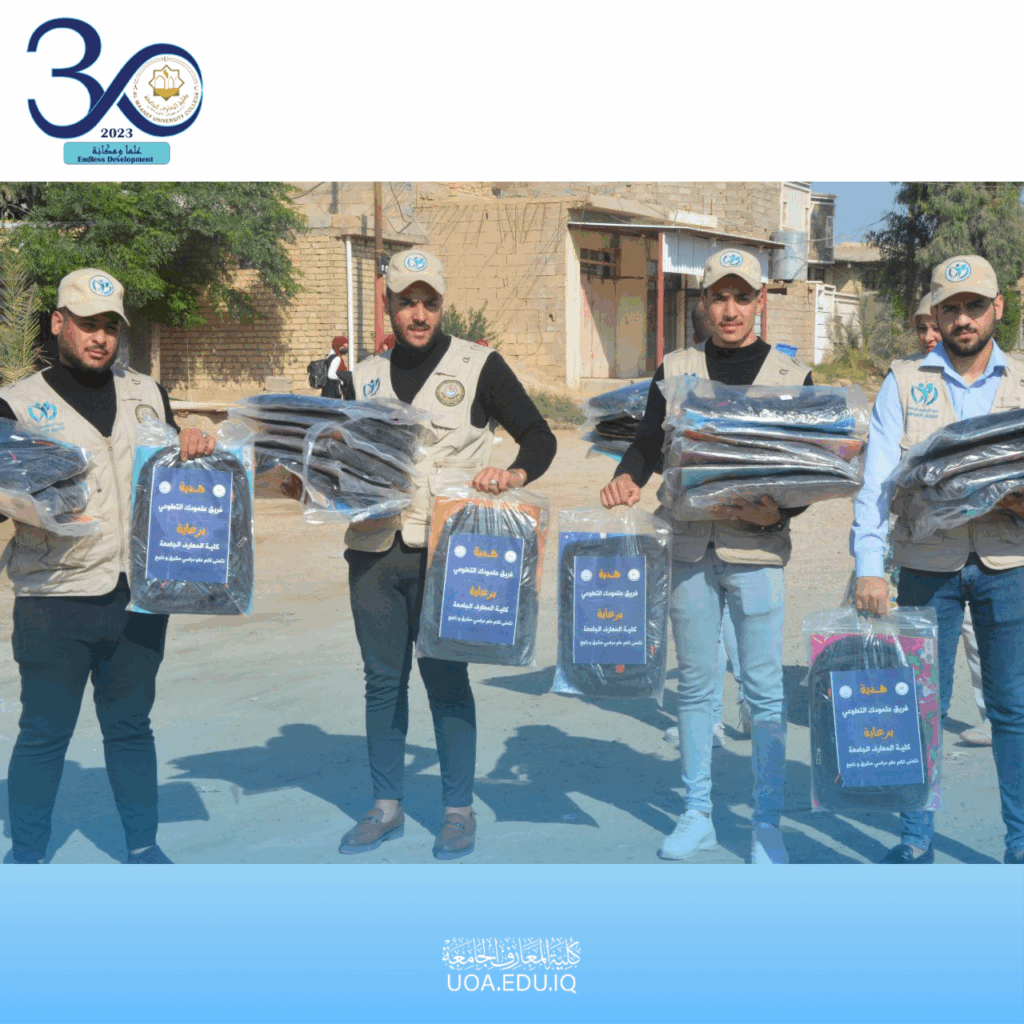
- The “Wateen Al-Maarif” Volunteer Club, which mobilizes students to distribute food parcels to fasting individuals and refugees, reaching more than 550 families annually in Anbar and Baghdad.
- Participation in the National Weight Loss and Nutrition Awareness Campaign, promoting health and dietary education among youth.
These initiatives reflect the University’s integration of faith-based values with sustainable development ethics — encouraging empathy, charity, and shared responsibility.
9. Innovation through Humanitarian Action and SDG Hackathons
UoA actively encourages youth innovation through its Humanitarian Action and SDG Hackathon, organized jointly with NGOs, technology companies, and humanitarian agencies.
The hackathon gathers students, engineers, social entrepreneurs, and researchers to develop practical solutions for food security, water management, and humanitarian logistics.
Key objectives include:
- Fostering awareness of humanitarian sectors and SDGs.
- Encouraging creative problem-solving for hunger and nutrition challenges.
- Supporting start-ups that combine social impact with economic feasibility.
- Building youth capacity in teamwork, innovation, and SDG-driven design.
The competition has generated prototypes for low-cost irrigation systems, solar-powered food dryers, and AI-based logistics tools for humanitarian supply chains.
10. Humanitarian Relief and Sustainable Food Systems
UoA’s humanitarian activities also intersect with relief and recovery efforts. Through its partnerships, the University participates in initiatives addressing:
- Food Security – providing emergency food packs during crises.
- Nutrition – supporting school feeding programs for vulnerable children.
- Health and Hygiene – integrating nutrition with health awareness.
- Shelter and Non-Food Assistance – coordinating with NGOs for comprehensive relief.
- Education and Training – linking SDG 2 with SDG 4 through community workshops.
These actions position UoA not only as an educational institution but as an essential community resilience partner in Iraq’s humanitarian landscape.
11. UoA’s Impact and Future Commitments
Between 2021–2024, UoA’s SDG 2 initiatives have produced tangible outcomes:
- 12,000+ meals distributed through humanitarian partnerships.
- 350 students engaged in Zero Hunger campaigns.
- 22 collaborative research papers on food security and sustainable farming.
- 15,000 community members reached through awareness programs.
Moving forward, UoA aims to:
- Establish a Center for Food and Nutrition Security (CFNS) to coordinate research and outreach.
- Expand hydroponic pilot farms to other provinces.
- Integrate AI data monitoring for regional food supply trends.
- Strengthen regional partnerships with FAO, WFP, and local NGOs to ensure inclusive progress.
12. Conclusion
The University of Al-Maarif’s efforts toward SDG 2 – Zero Hunger exemplify its dedication to advancing sustainable development through education, research, innovation, and community engagement. By linking science with compassion, and academia with action, the University contributes to the creation of a food-secure and equitable Iraq.
Through its inclusive initiatives — from sustainable agriculture and nutritional education to humanitarian food aid — UoA ensures that no one is left behind in the fight against hunger. The University’s holistic model demonstrates how higher education can drive sustainable solutions, empower communities, and sustain the vision of a world free from hunger and malnutrition.
Link: https://www.facebook.com/aucirq/videos/1647473969021604/