Introduction
The University of Al-Maarif (UOA) has long recognized that the protection of natural ecosystems, sustainable management of natural resources, and community environmental education are essential components of Iraq’s long-term development. Beyond the boundaries of its campus, UOA demonstrates its commitment to environmental stewardship through extensive off-campus conservation initiatives aimed at supporting biodiversity, restoring degraded environments, and promoting sustainable practices within the Al-Anbar Governorate and neighboring regions.
Located in western Iraq—an area characterized by arid climates, desertification risks, and water scarcity—UOA’s environmental engagement strategy emphasizes the dual mission of conservation and community empowerment. The university’s approach integrates academic research, student volunteerism, public-private partnerships, and policy advocacy to deliver measurable environmental impact.
These off-campus conservation efforts contribute directly to:
- SDG 6: Clean Water and Sanitation
- SDG 13: Climate Action
- SDG 15: Life on Land
- SDG 17: Partnerships for the Goals
Through collaborative action, scientific innovation, and education-based outreach, the University of Al-Maarif has positioned itself as a leading voice for sustainability and environmental leadership among Iraq’s higher education institutions.
1. Institutional Commitment and Policy Framework
1.1 Governance and Oversight
Off-campus conservation initiatives are guided by UOA’s Sustainability and Environmental Stewardship Policy (UOA-SES-2024) and supervised by the Sustainability and Global Ranking Unit (SGRU) under the Office of the Vice President for Administrative and Scientific Affairs.
The policy emphasizes:
- Integrating sustainability into academic, research, and community service activities.
- Supporting environmental projects that benefit surrounding communities.
- Establishing partnerships with governmental and non-governmental organizations.
- Ensuring transparent reporting of measurable environmental impact.
1.2 Policy Objectives
- Enhance biodiversity conservation beyond campus borders.
- Restore and protect water bodies, agricultural land, and desert habitats.
- Promote renewable energy and climate adaptation in local communities.
- Encourage volunteerism and civic participation among students.
- Align university activities with Iraq’s National Environmental Strategy and Action Plan (NESAP).
2. Key Areas of Off-Campus Conservation
UOA’s off-campus environmental strategy focuses on five interconnected pillars:
- Water and Ecosystem Conservation
- Reforestation and Land Rehabilitation
- Solid Waste and Pollution Control
- Renewable Energy and Climate Resilience Projects
- Community Education and Environmental Awareness
3. Water and Ecosystem Conservation
3.1 Euphrates River Rehabilitation and Awareness
The Euphrates River is Iraq’s most critical water source, providing irrigation, drinking water, and supporting diverse aquatic life. However, increasing pollution, sedimentation, and unregulated waste disposal threaten its ecosystem balance.
The University of Al-Maarif, through its College of Engineering and College of Allied Medical Sciences, partners with the Al-Anbar Water Directorate and the Ministry of Environment to monitor water quality and conduct cleanup operations along riverbanks in Ramadi and Fallujah.
Key Activities:
- Riverbank cleanups and waste removal campaigns under “Keep the Euphrates Alive”.
- Water quality testing for pH, turbidity, dissolved oxygen, and contaminants.
- Community workshops on household wastewater management.
- Student-led awareness campaigns on water pollution prevention.
Over 10,000 volunteers have participated since 2022, collecting 15 tons of plastic and solid waste, while improving community knowledge of water sustainability practices.
3.2 Wetland Protection and Biodiversity Monitoring
In partnership with the Habaniya Wetlands Authority, UOA researchers conduct biodiversity assessments and study migratory bird patterns. Faculty and students have documented over 40 bird species, creating Iraq’s first local wetland species database to support conservation planning.
3.3 Sustainable Irrigation and Water Reuse in Agriculture
Environmental engineering students collaborate with rural farmers to implement drip irrigation systems powered by solar pumps, reducing water usage by 35–40%. Workshops emphasize reusing greywater for landscape irrigation—transferring campus best practices into the broader community.
4. Reforestation and Land Rehabilitation
4.1 The “Green Al-Anbar Initiative”
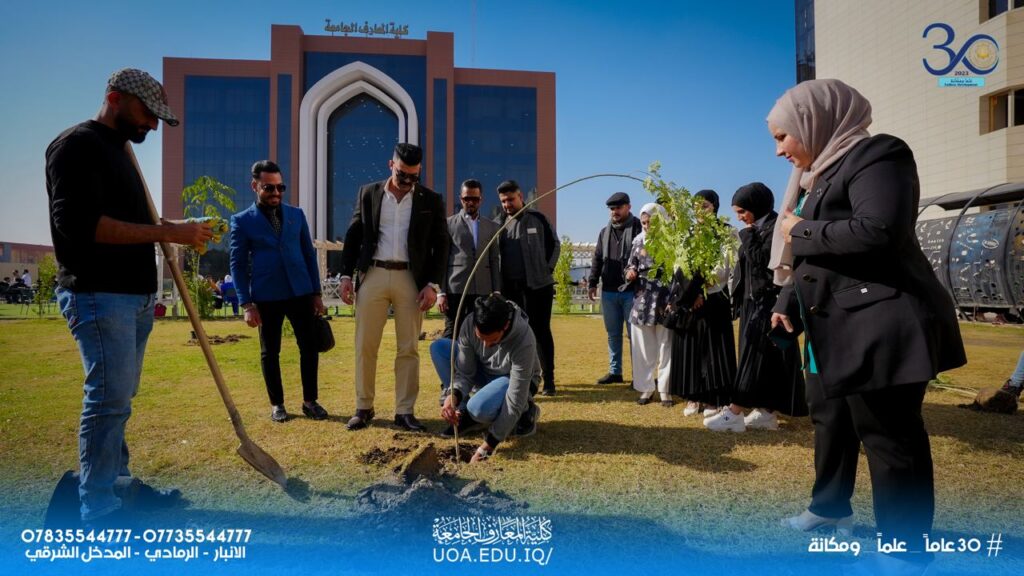
In response to desertification and soil erosion, UOA launched the “Green Al-Anbar Initiative” in 2021 to reforest degraded lands and expand green zones. Partnering with the Ministry of Agriculture, local municipalities, and NGOs, the program’s achievements include:
- 47,000 trees planted across Al-Anbar province.
- 12 hectares of barren land rehabilitated using drip irrigation and organic fertilizers.
- Priority planting of drought-resistant and native species such as acacia, tamarisk, and eucalyptus.
4.2 School Greening Program
Through its “School Green Corners Project,” the university works with local schools to establish mini-gardens and teach environmental stewardship. Students assist in building planter boxes, installing drip lines, and conducting environmental education sessions for children.
4.3 Research-Based Reforestation
The College of Engineering and Sustainability Research Group study soil quality and vegetation survival rates under different irrigation patterns to develop context-appropriate conservation models for Iraq’s semi-arid environment.
5. Solid Waste and Pollution Reduction
5.1 Community Clean-Up and Waste Sorting Projects
Since 2021, UOA has collaborated with Ramadi Municipality to organize large-scale cleanup drives in urban and rural areas. Student and faculty volunteers collect waste, separate recyclables, and raise awareness on the health and environmental impacts of improper disposal.
Over 22 tons of waste were removed during community campaigns in 2024 alone.
5.2 Plastic-Free Market Campaign
The “Plastic-Free Anbar” project, organized by the Deanship of Student Affairs, encourages market vendors to replace single-use plastics with biodegradable alternatives. The initiative has:
- Distributed 5,000 reusable bags.
- Partnered with three major supermarkets to adopt eco-packaging.
- Reduced monthly plastic bag usage by an estimated 10,000 units.
5.3 Waste-to-Resource Workshops
Engineering students train local waste workers on recycling, composting, and waste-to-energy concepts, fostering a circular economy mindset and supporting SDG 12 (Responsible Consumption and Production).
6. Renewable Energy and Climate Resilience
6.1 Solar Energy Demonstration Projects
UOA’s renewable energy outreach extends to public schools and clinics. Engineering faculty and students install solar-powered lighting systems for community buildings, improving access to electricity while reducing carbon emissions.
To date, 10 rural schools have benefited from the project, saving approximately 15,000 kWh annually.
6.2 Biogas for Sustainable Rural Livelihoods
In collaboration with the Anbar Agricultural Directorate, UOA implemented small-scale biogas units that convert livestock manure into clean cooking gas. The system benefits 25 rural households, reducing reliance on firewood and mitigating deforestation.
6.3 Climate Resilience Workshops
Public lectures on climate adaptation, heat management, and water conservation are conducted with support from local authorities. These events educate communities on coping with Iraq’s increasing temperature extremes and drought cycles.
7. Community Environmental Education
7.1 School Awareness Visits
Under the “Eco-Schools of Al-Anbar” program, university volunteers conduct educational visits to schools across the governorate. Interactive activities include:
- Demonstrations on recycling and composting.
- Games teaching the water cycle and pollution prevention.
- Tree planting and garden maintenance with students.
Over 3,500 schoolchildren have participated, fostering a culture of environmental responsibility among youth.
7.2 Women and Environment Workshops
In partnership with the Women Empowerment Directorate, UOA organizes awareness sessions for women on household energy efficiency, water reuse, and environmental entrepreneurship, enabling them to lead sustainability practices at the family and community level.
7.3 University–Community Dialogue Series
Quarterly forums bring together policymakers, academics, and citizens to discuss topics like sustainable agriculture, river protection, and environmental justice. These sessions have informed local environmental policies and fostered mutual learning.
8. Research and Innovation
UOA’s commitment to evidence-based environmental action drives innovation in sustainable technology and environmental sciences.
8.1 Research Projects
- Desert Soil Carbon Restoration: Faculty researchers are studying biochar application to restore soil fertility and enhance carbon sequestration.
- Water Reuse Modeling: Students develop digital simulations for greywater reuse systems suitable for Iraqi households.
- Microplastic Detection: UOA’s Medical Laboratory Department collaborates with the Ministry of Health to analyze microplastic levels in local water sources.
8.2 Student Innovation Competitions
Annual events such as the “UOA Green Innovation Challenge” reward student teams for developing creative sustainability projects. Winning ideas include solar water heaters, biodegradable packaging, and low-cost filtration devices.
8.3 Research Dissemination
Results from these projects are presented in regional conferences and published in UOA’s Sustainability Science Journal, contributing to the broader academic community’s understanding of conservation in arid regions.
9. Partnerships and Collaboration
Partnership is central to UOA’s conservation strategy. The university maintains active collaboration with:
| Partner | Role in Collaboration |
|---|---|
| Ministry of Environment | Joint clean-up and policy development |
| Ministry of Water Resources | Water quality monitoring and irrigation projects |
| Anbar Governorate Council | Infrastructure and awareness campaign support |
| Iraqi Red Crescent Society | Health and environmental awareness |
| UNDP Iraq | Technical funding and training workshops |
| Local NGOs (e.g., Green Iraq, Al-Khair Foundation) | Volunteer coordination and fieldwork assistance |
Through these collaborations, UOA ensures that conservation efforts are sustainable, community-oriented, and consistent with national environmental objectives.
10. Monitoring, Evaluation, and Impact Assessment
10.1 Data Collection and Reporting
The Sustainability and Global Ranking Unit (SGRU) oversees documentation of all off-campus environmental projects using standardized metrics, including:
- Number of beneficiaries.
- Volume of waste collected.
- Area reforested.
- Water saved or reused.
- CO₂ emissions reduced.
10.2 Quantitative Results (2024 Data)
| Indicator | Result |
|---|---|
| Trees planted | 47,000 |
| Hectares of land restored | 12 |
| Plastic bags replaced | 10,000+ |
| Waste collected | 22 tons |
| Farmers trained | 350 |
| School students reached | 4,500 |
| CO₂ reduced | 95 tons/year |
10.3 Impact Evaluation
Surveys conducted by the university’s Community Engagement Center indicate:
- 82% of participants reported improved environmental awareness.
- 63% adopted at least one sustainable habit post-program (e.g., recycling, water saving).
- 40% of farmers trained implemented new irrigation technologies.
11. Inclusivity and Equity in Environmental Action
UOA’s conservation initiatives prioritize inclusivity, ensuring participation from diverse community groups.
- Gender Inclusion: Women lead more than 50% of outreach and education campaigns.
- Youth Participation: Student volunteers form the backbone of environmental projects.
- Rural Engagement: Programs target underdeveloped villages and vulnerable populations most affected by environmental degradation.
By ensuring that sustainability is shared and participatory, UOA strengthens social equity and collective environmental responsibility.
12. Challenges and Mitigation Strategies
| Challenge | Mitigation |
|---|---|
| Limited funding for large-scale projects | Secured joint grants with UNDP and private donors |
| Harsh desert conditions affecting tree survival | Implemented greywater drip irrigation and mulching |
| Public skepticism or low engagement | Strengthened communication via social media and workshops |
| Waste disposal logistics | Partnered with local authorities for continuous waste collection |
These adaptive strategies ensure project continuity despite external constraints.
13. Future Directions
The University of Al-Maarif plans to expand its off-campus conservation initiatives through:
- Establishing a Regional Center for Environmental Studies to coordinate joint research and training.
- Expanding the “Green Anbar Corridor” to include 10 more municipalities.
- Launching the Water Literacy Academy for community-based training in water reuse and management.
- Developing a Carbon Accounting System to monitor emission offsets.
- Integrating Citizen Science Platforms that allow local residents to report environmental data.
These strategic expansions will ensure that UOA’s sustainability work continues to evolve, driving local and national progress.
14. Alignment with UN Sustainable Development Goals
| SDG | Contribution of UOA Off-Campus Conservation Programs |
|---|---|
| SDG 6 – Clean Water and Sanitation | River cleanups, water efficiency training, greywater reuse. |
| SDG 11 – Sustainable Cities and Communities | Waste reduction, urban greenery, and public engagement. |
| SDG 13 – Climate Action | Carbon reduction, climate adaptation training. |
| SDG 15 – Life on Land | Reforestation, biodiversity protection, desert reclamation. |
| SDG 17 – Partnerships for the Goals | Collaboration with ministries, NGOs, and UN agencies. |
Conclusion
The University of Al-Maarif (UOA) exemplifies how higher education institutions can transcend their academic boundaries to become active agents of environmental change. Through its Off-Campus Conservation Initiatives, the university not only protects Iraq’s fragile ecosystems but also educates, empowers, and mobilizes its citizens toward a sustainable future.
By combining science, service, and civic responsibility, UOA continues to set a benchmark for environmental leadership, contributing meaningfully to the realization of Iraq’s sustainable development vision and the global SDGs.