
Introduction
The University of Al-Maarif (UOA) is deeply engaged in advancing research, innovation, and sustainable solutions in the field of clean and renewable energy, in alignment with Sustainable Development Goal 7: Affordable and Clean Energy and national strategic goals for energy security in Iraq. As Iraq continues to face challenges related to increasing energy demand, dependence on fossil fuels, limited energy diversification, and environmental pressures, the role of the academic sector in shaping sustainable energy solutions has become increasingly critical. Recognizing these realities, UOA has positioned itself as a regional contributor in clean energy research by fostering interdisciplinary collaboration, applied research, and problem-solving approaches tailored to local and national needs.
Clean energy research at UOA brings together expertise from the Faculty of Engineering and Medical Devices Technologies, the Faculty of Science, the Faculty of Computer Science and Information Technology, the Sustainability and Global Ranking Unit, and several applied research laboratories. The university’s research focuses on solar energy systems, energy-efficient infrastructure, smart building technologies, low-power embedded systems, heat management, waste-to-energy solutions, and public awareness programs on sustainable energy consumption.
UOA’s approach emphasizes the integration of research, education, and community engagement. The university supports undergraduate and postgraduate research projects, faculty publications, applied research grants, industry collaborations, international scientific exchange, and campus-based living laboratories that allow students and researchers to experiment directly with real-world energy technologies.
This long-term institutional commitment contributes to:
| SDG Goal | Contribution Area | UOA Focus |
|---|---|---|
| SDG 7 | Clean and renewable energy solutions | Solar systems, energy efficiency, smart buildings |
| SDG 9 | Innovation, industry, and infrastructure | Technological R&D, prototypes, and industrial cooperation |
| SDG 11 | Sustainable cities and communities | Green campus planning and public awareness programs |
| SDG 12 | Responsible consumption and production | Energy efficiency and behavioral change strategies |
| SDG 13 | Climate action | Research on carbon reduction and heat mitigation solutions |
| SDG 17 | Partnerships for development | Local and international research collaborations |
Through these efforts, UOA demonstrates how universities can act as drivers of sustainable development, accelerating the transition to clean energy in ways that are scientifically grounded, economically viable, and culturally relevant.
Institutional Research Framework Supporting Clean Energy
1. Research Funding and Academic Support
The Deanship of Scientific Research routinely funds faculty projects and student research that address:
Solar power optimization
Smart grid modeling
Low-energy sensor and device systems
Heat and light efficiency in buildings
Renewable energy storage systems
2. Interdisciplinary Energy Research Clusters
Teams include:
Electrical and electronics engineers
Mechanical and energy engineers
Software and control systems developers
Environmental scientists and sustainability specialists
3. Laboratory and Technological Infrastructure
Key labs supporting clean energy research at UOA include:
Embedded Systems and IoT Lab (smart renewable energy monitoring)
Power Electronics and Control Systems Lab (solar power conditioning)
Materials Science and Nanotechnology Lab (photovoltaic efficiency research)
Thermal Engineering and Heat Transfer Lab
These facilities enable simulation, prototyping, testing, and systems integration research.
Core Research Themes and Contributions
A. Solar Energy Optimization and Application Research
Given Iraq’s abundant sunlight, UOA prioritizes research that improves:
Solar photovoltaic (PV) efficiency
Thermal regulation in PV panel systems
Hybrid solar energy conversion technologies
Smart solar tracking devices
Recent student and faculty work includes:
Development of dual-axis solar tracking systems for increased energy capture
Research on dust and environmental effects on long-term PV efficiency in western Iraq
Simulation and real testing of solar-powered cooling units for rural clinics and schools
These innovations are designed to reduce reliance on diesel generators and reduce long-term operational costs.
B. Smart Building and Energy-Efficient Infrastructure
UOA researchers are working on integrating smart energy management systems within buildings, including:
LED-based lighting networks with automated daylight compensation
Sensor-driven HVAC regulation systems
Heat-insulating façade materials for energy conservation
Occupancy-based power usage scheduling systems
This research is directly applied on the UOA campus through smart-building pilot zones that serve as living laboratories, where students learn from real-time performance data and environmental sensors.
C. Low-Power Devices, IoT, and Embedded Energy Systems
The Faculty of Medical Devices and Engineering maintains a special research focus on:
Low-energy embedded processing systems
IoT-based renewable energy monitoring platforms
Microcontroller-based efficiency optimization technologies
Example outputs include:
Real-time solar energy monitoring dashboard systems
Low-power irrigation controllers using renewable energy feeds
Predictive maintenance algorithms for solar installations using sensor networks
These systems support scalability and sustainability, especially in rural electrification settings.
D. Waste-to-Energy and Sustainable Fuel Research
In collaboration with environmental science researchers, UOA investigates:
Conversion of agricultural waste into biofuels
Heat-recovery systems from industrial waste
Feasibility studies for municipal solid waste energy recovery
This research promotes circular economy models, reducing landfill dependency and lowering carbon emissions.
E. Climate Impact, Heat Mitigation, and Energy Demand Forecasting
Researchers analyze:
Climate change impacts on electricity consumption in the Anbar region
Seasonal heatwave response planning
Cooling demand vs renewable energy availability curves
This research helps local authorities plan:
Cooling infrastructure
Public health protection policies
Solar grid balancing strategies
Public Awareness, Training, and Capacity-Building
The university runs:
Student training in renewable energy systems installation
Public lectures on energy conservation and climate adaptation
Capacity-building workshops for engineers, municipal staff, and educators
Awareness efforts emphasize behavioral energy management, encouraging:
Reduced unnecessary electricity use
Efficient cooling practices
Community adoption of solar technologies
Faculty Publications and Research Output
UOA researchers publish in:
Renewable energy engineering journals
Environmental sustainability journals
Applied physics and electronics journals
Research topics frequently include:
| Focus Area | Output Types |
|---|---|
| PV performance under local climate conditions | Case studies, datasets, modeling papers |
| Smart building energy systems | System architectures, software prototypes |
| Biofuel and waste-to-energy | Chemical and environmental performance assessments |
| IoT energy control systems | Hardware-software integration research |
The university supports joint student-faculty authorship to cultivate research culture early.
Partnerships and Collaboration Networks
UOA collaborates with:
Renewable energy companies
National and local energy authorities
International research institutions
Community development organizations
These partnerships ensure research outcomes translate into real-world implementation.
| # | Research Title | Link |
|---|---|---|
|
1 |
Graphene and carbon structures and nanomaterials for energy storage
|
|
|
2 |
Comprehensive review on the Bis–heterocyclic compounds and their anticancer efficacy |
|
|
3 |
Application of extracellular vesicles derived from mesenchymal stem cells as potential therapeutic tools in autoimmune and rheumatic diseases |
|
|
4 |
Cytotoxicity evaluation of environmentally friendly synthesis Copper/Zinc bimetallic nanoparticles on MCF-7 cancer cells |
|
|
5 |
Shining the light on clinical application of mesenchymal stem cell therapy in autoimmune diseases
|
|
|
6 |
Effects of sulfur dioxide inhalation on human health: A review |
|
|
7 |
Anticancer Drug-Loading Capacity of Green Synthesized Porous Magnetic Iron Nanocarrier and Cytotoxic Effects Against Human Cancer Cell Line |
|
|
8 |
Engineering and surface modification of carbon quantum dots for cancer bioimaging |
|
|
9 |
Application of aluminum nitride nanotubes as a promising nanocarriers for anticancer drug 5-aminosalicylic acid in drug delivery system |
|
|
10 |
Development of ensemble machine learning approaches for designing fiber-reinforced polymer composite strain prediction model |
 |
|---|
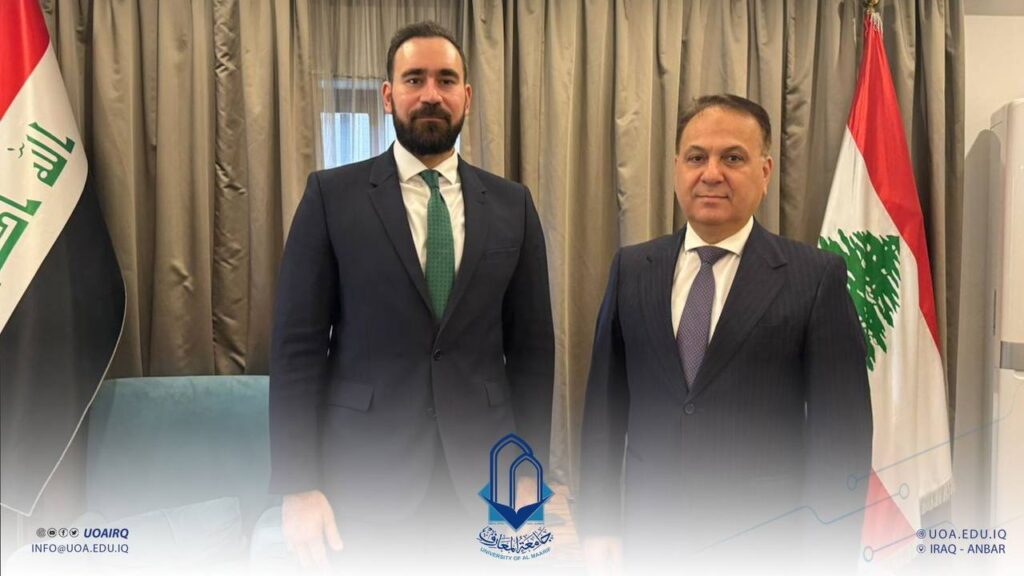
University of Al-Maarif Enhances Cooperation and Shares Knowledge with Lebanese Universities in the Field of Renewable Energy |
The Rector’s Scientific Assistant at the University of Al-Maarif, Dr. Mahmood Abd Al-Razaq Abd Al-Rahman, met with the Lebanese Ambassador to the Republic of Iraq, Mr. Ali Al-Habhab, to discuss mechanisms for cooperation between the University of Al-Maarif and Lebanese universities. The meeting focused on strengthening academic collaboration, exchanging knowledge and expertise, and developing joint scientific and educational initiatives that benefit both countries. The discussion also highlighted the importance of renewable energy and its role in supporting sustainable development, emphasizing opportunities for future cooperation in research and innovation to enhance academic and scientific capacities on both sides. |