Introduction
The University of Al-Maarif (UOA) has made water conservation, education, and sustainability awareness central pillars of its campus environmental strategy. Located in Al-Anbar, Iraq, a region that experiences water scarcity and climate stress, UOA recognizes that sustainable water management is not only an environmental necessity but also a social and educational responsibility. The university is therefore committed to promoting awareness among students, faculty, and staff about the value of water, efficient use, and long-term stewardship of natural resources.
The Campus Water Awareness Program (CWAP) is part of UOA’s broader sustainability agenda, which integrates teaching, research, and community engagement to foster a culture of environmental consciousness and responsible behavior. This program aligns directly with Sustainable Development Goal 6 (Clean Water and Sanitation) and complements SDG 4 (Quality Education), SDG 11 (Sustainable Cities and Communities), and SDG 13 (Climate Action) by educating the university community on the importance of water conservation, pollution prevention, and ecosystem protection.
The university’s approach to water awareness is holistic—it combines scientific education, infrastructure innovation, student engagement, and public outreach. Through workshops, exhibitions, campaigns, and digital platforms, UOA ensures that every member of its community understands how personal habits and institutional practices can collectively impact water sustainability.
1. Strategic Framework and Governance
The Campus Water Awareness Program is coordinated by the Environmental Sustainability and Global Ranking Unit (ESGRU) in collaboration with the Engineering Department, Deanship of Student Affairs, and the College of Allied Medical Sciences. The initiative operates under the university’s Sustainability and Environmental Management Policy (SEMP-2024), which establishes guiding principles for campus operations, education, and engagement in line with the UN SDGs.
Objectives
- Increase knowledge of sustainable water practices among students and staff.
- Integrate water sustainability into teaching, research, and extracurricular activities.
- Promote behavior change through participatory campaigns and competitions.
- Reduce water waste on campus by fostering a sense of collective responsibility.
These goals are monitored annually through measurable key performance indicators (KPIs) related to participation, awareness levels, and reduction in campus water consumption.
2. Water Awareness and Education Integration
UOA embeds water sustainability education across academic disciplines, ensuring that awareness is not limited to a single department but integrated into the university’s educational framework.
2.1 Academic Curriculum Integration
- Engineering and Environmental Sciences Programs include modules on water resource management, smart irrigation systems, and hydrological modeling.
- Health and Medical Sciences Courses address public health aspects of water sanitation and hygiene (WASH).
- Business and Management Programs explore the economics of water efficiency and sustainable business practices.
- General Education Curriculum introduces all first-year students to sustainability principles, including water and resource conservation.
This curricular integration ensures that every graduate of UOA leaves the university with a foundational understanding of environmental stewardship and sustainable development.
2.2 Laboratory and Field-Based Learning
Students from engineering, environmental, and health disciplines participate in field research projects and laboratory experiments related to water treatment, greywater recycling, and pollution analysis. This hands-on approach connects theory to practice and reinforces awareness through experience.
3. Awareness Campaigns and Events
UOA organizes a variety of campaigns and events to promote water conservation and environmental protection across campus and within the community.
3.1 World Water Day Celebrations
Each year, the university celebrates World Water Day (March 22) under themes aligned with the UN’s annual global focus. Events include:
- Student poster exhibitions illustrating local water issues.
- Public lectures by faculty and guest speakers from the Ministry of Water Resources.
- Water-saving demonstrations and interactive activities.
- Competitions for innovative ideas in water conservation technologies.
The 2025 celebration theme, “Water for Peace and Prosperity,” brought together students from all colleges to discuss Iraq’s water challenges and propose youth-led solutions for sustainable management.
3.2 “Every Drop Matters” Campaign
This student-led campaign was launched in partnership with the Deanship of Student Affairs and focuses on reducing water waste in restrooms, laboratories, and cafeterias. Activities include:
- Awareness posters near water sources.
- Short educational videos shared through social media.
- Distribution of eco-friendly water bottles.
- Competitions for the “Most Water-Efficient Department.”
The campaign’s success led to measurable reductions in water use—approximately 12% over two semesters—according to the Engineering Unit’s monitoring reports.
3.3 Clean Water and Hygiene Week
Organized annually by the College of Allied Medical Sciences, this week-long program includes seminars, exhibitions, and outreach to schools in Al-Anbar. Topics include:
- The relationship between clean water and disease prevention.
- Household water treatment methods.
- The role of youth in achieving SDG 6.
Students provide live demonstrations of portable water filters and hygiene kits, promoting both scientific understanding and civic engagement.
4. Student and Staff Engagement Initiatives
Awareness at UOA is strengthened by student and staff participation in sustainability-driven initiatives.
4.1 Water Ambassadors Program
The Water Ambassadors are trained student volunteers who serve as peer educators and advocates for responsible water use. Their responsibilities include:
- Conducting classroom awareness sessions.
- Monitoring water usage in dormitories.
- Assisting in campaign organization.
- Leading social media advocacy on conservation behavior.
By the end of 2024, over 60 Water Ambassadors were trained, representing all faculties.
4.2 Faculty Workshops
Faculty and administrative staff attend annual sustainability orientation sessions, where they receive updates on campus resource efficiency and contribute to developing departmental sustainability plans. Sessions emphasize reducing lab water waste, maintaining efficient cooling systems, and fostering student engagement.
4.3 Student Research and Innovation Competitions
The university hosts the annual UOA Sustainability Innovation Challenge, encouraging students to propose smart solutions for water efficiency. Projects have included:
- IoT-enabled irrigation controllers.
- Campus water footprint calculators.
- AI-based predictive maintenance for leaks.
Winning teams receive funding to pilot their innovations within the campus.
5. Communication and Outreach Tools
UOA’s awareness campaigns rely on creative, technology-based communication methods to reach diverse audiences.
5.1 Visual Awareness Materials
Informational posters, infographics, and billboards across campus display simple messages such as:
- “Save Water—Every Drop Counts.”
- “Report Leaks Immediately.”
- “Smart Habits, Sustainable Campus.”
- “Turn Off the Tap—Your Action Matters.”
These visuals are strategically placed in high-traffic areas—restrooms, cafeterias, labs, and gardens—to remind users of their role in conservation.
5.2 Digital Platforms
The UOA Sustainability Portal and official Instagram, Facebook, and Telegram channels feature educational content, videos, and reports about the university’s water initiatives. Monthly “eco-challenges” invite students to share their personal water-saving efforts online, fostering collective accountability.
5.3 Campus Radio and Announcements
The university’s internal radio and PA systems broadcast short awareness messages about water conservation, encouraging behavioral change through repetition and familiarity.
6. Partnerships and Collaboration
The University of Al-Maarif collaborates with national and local organizations to expand its water awareness reach.
6.1 Ministry and Municipal Cooperation
UOA partners with the Ministry of Water Resources, the Iraqi Environment Directorate, and the Al-Anbar Water Authority to host educational seminars, policy dialogues, and joint field visits for students.
6.2 NGO and Private Sector Collaboration
Non-governmental organizations such as the Iraqi Red Crescent Society, UNDP Iraq, and local water technology companies collaborate with UOA to provide technical expertise and materials for awareness events.
6.3 School and Community Partnerships
University students conduct school visits to teach children about water saving, proper sanitation, and environmental protection, extending awareness beyond campus boundaries.
7. Infrastructure Demonstrations for Awareness
UOA leverages its campus infrastructure as a living laboratory for water sustainability education.
- Water Reuse System Demonstration Units: Display how greywater is collected, treated, and reused for landscaping.
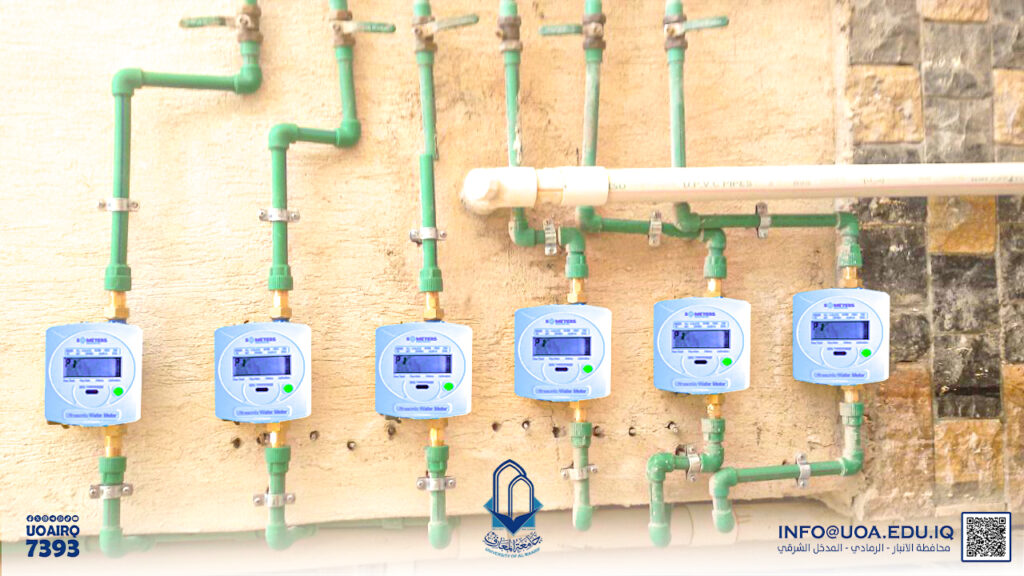
- Water Metering Display Board: Shows real-time water consumption for transparency.
- Model Smart Irrigation Garden: Used for tours and training by engineering and agriculture students.
- Green Roof Pilot Project: Demonstrates stormwater retention and urban cooling benefits.
These physical demonstrations provide visual reinforcement for theoretical knowledge and encourage visitors to apply sustainable practices in their communities.
8. Research and Knowledge Dissemination
Water awareness at UOA is supported by active research in engineering, environmental science, and public health.
8.1 Faculty Research Projects
Faculty research topics include:
- Groundwater quality monitoring in Al-Anbar.
- Solar-powered desalination systems.
- Urban runoff management and reuse.
- Sustainable campus water footprint analysis.
8.2 Student Projects
Graduate and undergraduate students are encouraged to conduct research linked to water management. Their work often feeds into community awareness materials and local policy recommendations.
8.3 Publications and Conferences
UOA hosts the Annual Sustainable Development Research Forum, where water-related studies are presented. Selected papers are published in the university’s Journal of Environmental and Engineering Sciences, amplifying awareness through academic dissemination.
9. Monitoring and Evaluation of Awareness Outcomes
The effectiveness of water awareness initiatives is measured through structured evaluation processes.
9.1 Pre- and Post-Program Surveys
Before and after major campaigns, surveys assess changes in participants’ knowledge, attitudes, and behaviors toward water conservation.
9.2 Water Consumption Metrics
The Engineering Unit correlates awareness activities with changes in actual water consumption, identifying behavioral shifts and efficiency improvements.
9.3 Feedback Mechanisms
Suggestion boxes, QR-coded feedback forms, and social media polls collect insights from students and staff, informing future awareness strategies.
10. Inclusiveness and Accessibility in Water Awareness
Water awareness campaigns at UOA emphasize inclusivity and social equity.
- Gender Inclusion: Female students lead many awareness campaigns, ensuring representation in decision-making and visibility in advocacy.
- Accessibility: Materials are designed in clear Arabic and English, with visual aids for those with limited literacy.
- Community Reach: Awareness sessions extend to villages surrounding Al-Anbar, ensuring local engagement in regional water issues.
This inclusivity reinforces the university’s commitment to equitable education and civic participation.
11. Community and Regional Impact
UOA’s water awareness activities extend far beyond the campus, influencing the broader Al-Anbar community.
- Local residents report improved understanding of household water management.
- Schools replicate UOA’s educational materials for student use.
- Municipal leaders consult university experts on water efficiency initiatives.
Through these outcomes, UOA contributes tangibly to Iraq’s national efforts toward achieving SDG 6 and sustainable water security.
12. Quantitative Indicators (Sample 2024 Data)
| Indicator | Description | 2024 Value |
|---|---|---|
| Number of water awareness events | Workshops, lectures, campaigns, and exhibitions | 38 |
| Total participants | Students, staff, and community members | 6,800+ |
| Reduction in campus water use | Based on annual audit | 14% |
| Number of students trained as Water Ambassadors | Across all colleges | 60 |
| Number of schools reached through outreach | Local public schools | 12 |
| Social media reach | Combined audience for water awareness posts | 25,000+ |
These metrics reflect significant progress in both behavioral change and community participation.
13. Governance and Policy Integration
The University of Al-Maarif Water Awareness and Conservation Policy (UOA-WACP-2024) formalizes the campus’s commitment to sustainable water education. Key features include:
- Mandatory annual awareness campaigns for all departments.
- Requirement for sustainability integration in new faculty orientations.
- Cross-departmental coordination under the Vice President for Administrative Affairs.
- Reporting through the annual Sustainability and SDG Progress Report.
This governance framework ensures continuity, accountability, and measurable progress toward long-term water conservation goals.
14. Future Directions
UOA aims to further advance its water awareness mission through innovative and strategic initiatives, including:
- Smart Water Awareness App: A mobile platform providing real-time data, quizzes, and conservation tips for students.
- Regional Water Awareness Summit: An annual event bringing together universities, municipalities, and NGOs.
- Sustainability Education Module for Schools: Curriculum materials developed by UOA for secondary education.
- Expansion of Water Ambassadors Network: Engaging alumni and community representatives.
- Partnership with the Ministry of Education: To integrate water awareness activities into national educational programs.
These future plans demonstrate UOA’s long-term vision of becoming Iraq’s leading model for sustainable water education and awareness.
15. Alignment with the Sustainable Development Goals
The Campus Water Awareness Program at UOA supports multiple SDGs:
| SDG | Contribution |
|---|---|
| SDG 6 – Clean Water and Sanitation | Promoting water efficiency, sanitation awareness, and pollution prevention. |
| SDG 4 – Quality Education | Delivering lifelong learning opportunities related to environmental stewardship. |
| SDG 11 – Sustainable Cities and Communities | Educating citizens to contribute to sustainable urban development. |
| SDG 12 – Responsible Consumption and Production | Encouraging efficient resource use and behavioral change. |
| SDG 13 – Climate Action | Raising awareness on climate-water interdependence. |
| SDG 17 – Partnerships for the Goals | Strengthening collaboration with ministries, NGOs, and community stakeholders. |
Conclusion
The University of Al-Maarif (UOA) exemplifies how higher education institutions can lead by example in promoting environmental awareness, sustainable behavior, and civic responsibility. Through its Campus Water Awareness Program, UOA has transformed its campus into a living laboratory for water education—where knowledge, technology, and community engagement converge to build a culture of sustainability.
By educating thousands of students, faculty, and community members on water conservation and efficiency, UOA contributes meaningfully to the global agenda for sustainable water management and climate resilience. The university’s approach—integrating academic excellence, social commitment, and environmental responsibility—reflects a deep understanding that awareness is the foundation of action and that the future of Iraq’s environment depends on informed and empowered citizens.
The University of Al-Maarif remains committed to advancing the message that “Every Drop Counts”, inspiring generations to protect, preserve, and wisely manage water resources for the benefit of humanity and the planet.