
Introduction
The University of Al-Maarif (UOA) demonstrates its firm commitment to sustainable water management and environmental protection through the systematic measurement, monitoring, and optimization of water reuse across its campus facilities. Located in Al-Anbar, Iraq, a region characterized by arid climatic conditions and limited water resources, the university has made water efficiency and reuse a cornerstone of its sustainability strategy.
Aligned with United Nations Sustainable Development Goal 6 (Clean Water and Sanitation), particularly Target 6.4, which emphasizes substantially increasing water-use efficiency across all sectors and ensuring sustainable freshwater withdrawals, UOA has implemented a robust Water Reuse Measurement and Management Framework. This framework integrates engineering innovation, laboratory-based water quality assessment, digital monitoring, and academic research to ensure that every cubic meter of reused water is accurately quantified, treated, and utilized responsibly.
Through these comprehensive efforts, UOA not only reduces its environmental footprint but also serves as a national model for sustainable higher education institutions managing scarce natural resources through evidence-based and data-driven systems.
1. Institutional Framework for Water Reuse
The University of Al-Maarif’s water reuse system operates under a structured institutional framework designed to ensure efficiency, accountability, and scientific precision. The framework consists of three core units:
- Engineering and Facilities Management Unit – Oversees the design, operation, and maintenance of the water distribution and treatment infrastructure, ensuring compliance with engineering and safety standards.
- Environmental and Sustainability Unit (ESU) – Monitors key performance indicators (KPIs) related to water conservation, reuse, and waste reduction, integrating findings into the university’s annual sustainability report.
- Water Quality and Laboratory Analysis Unit – Conducts periodic testing and verification of reused water parameters, ensuring alignment with Iraqi Environmental Regulations and World Health Organization (WHO) guidelines for non-potable reuse.
Together, these units ensure that water reuse at UOA is not a passive byproduct of wastewater treatment but an actively monitored process that supports sustainability, operational efficiency, and research-driven innovation.
2. Definition and Scope of Water Reuse at UOA
At the University of Al-Maarif, “water reuse” encompasses the reclamation, treatment, and safe utilization of previously used water from domestic, laboratory, and operational sources within the campus. The scope includes:
- Reclaimed wastewater reuse – Treated effluent from the on-campus wastewater treatment plant used for irrigation, cleaning, and cooling systems.
- Greywater reuse – Lightly contaminated water from washbasins and showers redirected for non-potable applications.
- Rainwater and stormwater collection – Captured runoff stored and filtered for landscaping use.
- Condensate recovery – Water collected from air-conditioning units reused in cleaning and maintenance.
This comprehensive reuse approach ensures that the university maximizes the potential of all available water resources, minimizes waste, and contributes to sustainable campus development.
3. Wastewater Treatment and Recovery System
3.1 Collection and Segregation
UOA’s campus employs a dual piping system that segregates domestic wastewater from stormwater runoff and laboratory wastewater. Domestic wastewater and greywater are directed to the Central Treatment Facility, while stormwater is routed into collection tanks designed for filtration and temporary storage.
3.2 Treatment Process
The on-site wastewater treatment plant (WWTP) follows a three-stage process:
- Primary Treatment: Removal of solids and organic matter through sedimentation.
- Secondary Treatment: Biological degradation using activated sludge and aeration tanks.
- Tertiary Treatment: Filtration and disinfection through chlorination or UV radiation to achieve non-potable reuse standards.
The treated effluent is then transferred to reuse storage reservoirs, where it undergoes additional quality testing before being redistributed across campus for approved uses.
3.3 Operational Capacity
The treatment plant has an average processing capacity of 75 cubic meters per day, sufficient to cover the irrigation and cleaning needs of the university. This capacity ensures that approximately 45–55% of total campus water demand is met through reused sources, significantly reducing dependence on municipal water supplies.
4. Water Reuse Measurement and Data Collection System
Accurate measurement of reused water is critical to achieving accountability and transparency in sustainability reporting. The University of Al-Maarif has established a multi-tiered measurement and data collection system comprising manual and digital components.
4.1 Metering and Flow Measurement
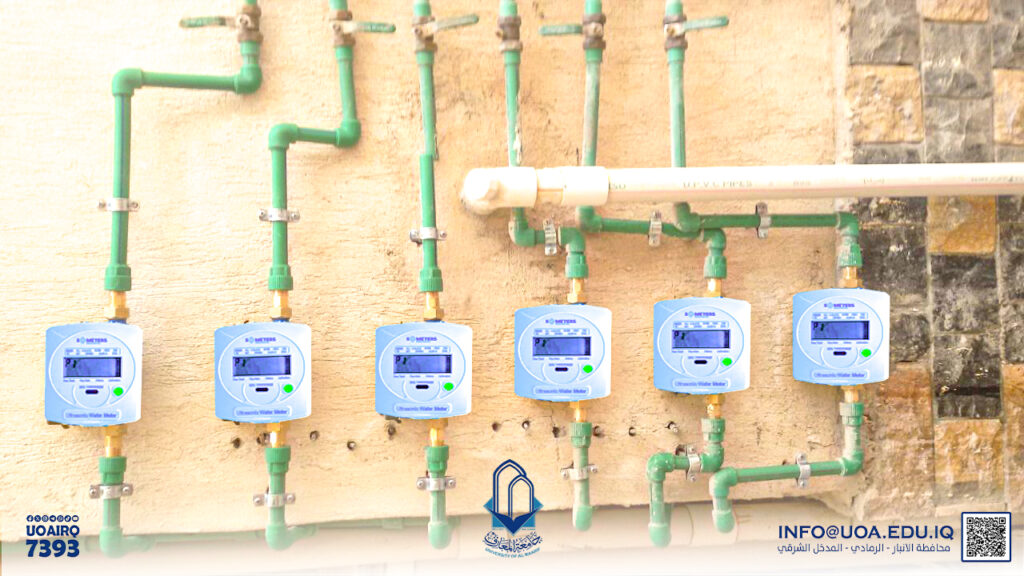
All major reuse outlets—such as irrigation pipelines, cleaning stations, and storage tanks—are equipped with digital flow meters calibrated according to international standards (ISO 4064). These meters record:
- Daily water flow rates (m³/day)
- Cumulative reuse volumes
- Pressure and temperature data
The collected data are transmitted to a centralized Water Monitoring Dashboard, maintained by the Engineering Unit, for real-time analysis and reporting.
4.2 Monthly Monitoring and Verification
Monthly measurement reports are compiled by the Facilities Management Department and verified by the Sustainability and Global Ranking Center (SGRC). These reports include:
- Total volume of treated wastewater generated.
- Total volume reused for irrigation and cleaning.
- Percentage of total campus water consumption covered by reused water.
- Comparative performance trends with previous months.
Verification involves cross-referencing readings from flow meters, laboratory water quality logs, and campus usage records, ensuring a high degree of accuracy.
4.3 Annual Audit and Benchmarking
An annual water audit is conducted to assess overall efficiency, losses, and sustainability improvements. The results are benchmarked against national and international university standards, particularly those outlined by UI GreenMetric and THE Impact Rankings frameworks.
5. Applications of Reused Water at UOA
The University of Al-Maarif applies reused water across multiple non-potable domains, each managed under strict operational guidelines to ensure safety and efficiency.
5.1 Irrigation of Landscaped Areas
Reused water is the primary source for irrigating the university’s 65,000 square meters of landscaped areas, including gardens, walkways, and sports fields. This reduces the reliance on fresh municipal water and helps maintain green spaces essential for air quality improvement and campus aesthetics.
5.2 Campus Cleaning and Sanitation
Treated water is used in cleaning outdoor pavements, courtyards, and parking lots, as well as for dust control—especially during dry seasons common in Al-Anbar. These activities collectively consume approximately 10% of the reused water supply.
5.3 Cooling Systems and Technical Use
In selected facilities, particularly the Engineering and Health Sciences buildings, treated water supports non-contact cooling towers and HVAC systems. The integration of reused water in technical applications contributes to both energy and water savings.
5.4 Construction and Maintenance
Reused water is supplied for small-scale construction projects, including cement mixing, surface cleaning, and landscaping maintenance, ensuring full resource utilization with minimal waste.
6. Water Quality Monitoring and Laboratory Analysis
Maintaining the quality of reused water is paramount for environmental safety and compliance. The University Chemistry Laboratory, in coordination with the Environmental Health and Safety Committee, conducts regular testing of water samples from the treatment facility.
6.1 Tested Parameters
Water quality testing covers physical, chemical, and microbiological parameters, including:
- TDS (Total Dissolved Solids)
- EC (Electrical Conductivity)
- BOD (Biochemical Oxygen Demand)
- COD (Chemical Oxygen Demand)
- pH, SO₄, Cl⁻, Mg, Ca, and Total Hardness (TH)
- Coliform and E. coli counts for microbiological safety.
6.2 Testing Frequency
- Weekly testing for key indicators (pH, EC, TDS)
- Bi-weekly testing for microbial and organic parameters
- Monthly comprehensive quality review
All data are recorded and archived in the Environmental Monitoring System (EMS) and included in the annual sustainability report.
7. Data Analysis and Performance Indicators
To evaluate progress, UOA tracks key Water Reuse Performance Indicators (WRPIs), which include:
| Indicator | Definition | Target (2025) | Current Performance (2024) |
|---|---|---|---|
| % of total campus water demand met through reuse | Reused water volume ÷ Total water consumption × 100 | ≥ 50% | 47.2% |
| Volume of treated wastewater reused annually | Cumulative volume of treated water redirected for use (m³/year) | 27,000 m³ | 24,800 m³ |
| Reduction in municipal water consumption | Yearly difference compared to baseline (2021) | -40% | -37% |
| Water reuse efficiency index | Treated water used ÷ Treated water produced × 100 | ≥ 95% | 92% |
These metrics are monitored continuously, allowing administrators to identify inefficiencies and improve system operations accordingly.
8. Research and Innovation in Water Reuse
The University of Al-Maarif integrates water reuse into its academic and research agenda, encouraging students and faculty to develop innovative approaches to water management.
8.1 Student Research Projects
Students from the College of Engineering and Department of Environmental Technology engage in applied research topics such as:
- Solar-assisted wastewater treatment.
- Nano-filtration materials for advanced water purification.
- Greywater reuse systems for domestic buildings.
8.2 Collaborative Studies
UOA collaborates with national institutions like the Ministry of Water Resources and University of Anbar on projects exploring water reuse optimization and climate-adaptive irrigation.
8.3 Publication and Dissemination
Research findings are published in national and international journals, contributing to Iraq’s scientific literature on water reuse and environmental sustainability.
9. Education, Awareness, and Capacity Building
To complement its technical initiatives, UOA promotes a culture of water conservation and awareness across its academic community.
- Workshops and Seminars: Regular training sessions are held for staff and students on efficient water use, reuse safety, and environmental responsibility.
- Awareness Campaigns: Annual events such as “World Water Day” feature exhibitions, quizzes, and poster competitions on the importance of water reuse.
- Community Outreach: The university collaborates with local schools to teach children about water conservation practices and simple household reuse techniques.
These educational initiatives reinforce behavioral change and cultivate environmental citizenship.
10. Digitalization and Smart Water Management
As part of its digital transformation, UOA employs smart monitoring systems to enhance water reuse efficiency and transparency.
- IoT-enabled Meters: Provide real-time readings of water flow, pressure, and temperature.
- Automated Alerts: Notify maintenance teams of anomalies such as leaks or system malfunctions.
- Data Dashboards: Aggregate usage metrics and generate visual reports accessible to administrators and sustainability officers.
- Predictive Analytics: Utilized to forecast water demand and optimize reuse planning under varying seasonal conditions.
This smart infrastructure ensures operational precision, cost efficiency, and measurable environmental impact.
11. Governance, Policy, and Compliance
The University of Al-Maarif Water Conservation and Reuse Policy (UOA-WRP-2023) provides the regulatory foundation for water reuse operations. The policy outlines:
- Clear responsibilities and accountability mechanisms.
- Annual performance review requirements.
- Compliance standards with Iraqi water quality laws and international best practices.
- Integration with the Environmental Management System (EMS) for documentation and reporting.
The policy is reviewed every two years to incorporate new technologies and regulatory updates.
12. Alignment with the Sustainable Development Goals (SDGs)
UOA’s Water Reuse Measurement system contributes directly to several SDGs:
| SDG | Contribution |
|---|---|
| SDG 6 – Clean Water and Sanitation | Reuse of treated wastewater, efficient monitoring, and safe water management. |
| SDG 9 – Industry, Innovation, and Infrastructure | Integration of digital technologies and research into water systems. |
| SDG 11 – Sustainable Cities and Communities | Creating water-efficient and eco-resilient campus infrastructure. |
| SDG 12 – Responsible Consumption and Production | Circular water management reducing waste and resource depletion. |
| SDG 13 – Climate Action | Mitigating the impact of droughts through efficient water recovery systems. |
| SDG 17 – Partnerships for the Goals | Collaborations with ministries, NGOs, and academic partners for sustainable water management. |
13. Environmental and Economic Impacts
The benefits of UOA’s water reuse measurement system extend beyond environmental conservation to include economic and operational advantages.
- Water Savings: Over 30,000 cubic meters of potable water saved annually.
- Cost Reduction: Approximately 25% decrease in municipal water expenditure.
- Energy Efficiency: Reduced energy consumption in pumping and water transport.
- Ecosystem Protection: Lower discharge into municipal drainage systems, minimizing pollution.
- Campus Resilience: Enhanced capacity to operate sustainably under water scarcity conditions.
14. Future Plans and Strategic Expansion
The University of Al-Maarif continues to expand its water reuse initiatives through forward-looking projects, including:
- Rainwater Harvesting Integration – Capturing rooftop runoff for irrigation.
- Expansion of Greywater Systems – Implementing decentralized greywater reuse in dormitories.
- Solar-Powered Treatment Units – Reducing carbon emissions from water processing.
- AI-based Water Management Software – Enhancing forecasting and optimization.
- Regional Knowledge Hub Establishment – Developing a center for water sustainability research in Iraq’s western region.
Conclusion
The University of Al-Maarif (UOA) exemplifies how data-driven water reuse management can transform environmental challenges into opportunities for sustainable growth. Through precise measurement, rigorous monitoring, and transparent reporting, the university ensures that every drop of water is utilized efficiently and responsibly.
UOA’s integrated system of treatment, reuse, and measurement demonstrates a holistic approach to environmental management that aligns seamlessly with the UN SDGs and sets a benchmark for higher education institutions across Iraq and the Arab region.
By continuing to innovate, educate, and lead by example, the University of Al-Maarif reinforces its role as a pioneer in sustainable campus operations, ensuring that water conservation and reuse remain central to its mission of building a resilient, green, and knowledge-driven future.