Introduction
The University of Al-Maarif (UOA) in the Republic of Iraq is deeply committed to fostering equitable, inclusive, and lifelong learning opportunities for all members of society. In alignment with the principles of the United Nations Sustainable Development Goal 4 (Quality Education), the university actively extends educational access beyond its enrolled students, ensuring that learning resources, academic spaces, intellectual enrichment opportunities, and capacity-building programs are made available to the broader community.
UOA’s philosophy of education is rooted in the belief that knowledge is a public good and that universities hold a vital responsibility not only to educate students enrolled within their programs, but also to uplift the intellectual and cultural development of surrounding communities. The university therefore prioritizes open, accessible, and community-oriented educational engagement, with initiatives spanning digital resources, physical library access, community seminars, research participation, public learning events, and outreach partnerships.
Over the past several years, UOA has expanded its open-access educational ecosystem, developing both physical and virtual platforms that allow schoolteachers, university applicants, researchers, youth groups, civil society actors, and independent learners to benefit from academic materials, lectures, workshops, and professional training. These efforts are managed in collaboration among the Deanship of Student Affairs, the University Library, the Sustainability and Global Ranking Unit, and various academic colleges and specialized centers.
By committing institutional resources to shared learning and knowledge exchange, UOA reinforces its role as a regional leader in promoting inclusive education, supporting intellectual growth, expanding community engagement, and strengthening the role of higher education in sustainable national development.
UOA’s Commitment to Open and Public Access Education
The University of Al-Maarif views open educational access as a multilayered model that includes:
Free access to physical educational facilities for non-students
Digital open-access learning platforms supporting remote learners
Public academic events and community seminars
Lifelong learning and adult education opportunities
Collaborative educational partnerships with schools, organizations, and local institutions
This model supports SDG Target 4.3, which calls for ensuring equal access for all women and men to affordable and quality tertiary education, and SDG Target 4.7, which emphasizes education for sustainable development, cultural understanding, and responsible citizenship.
Open Access to University Library and Learning Facilities
The UOA Central Library as a Community Learning Hub
The University of Al-Maarif Central Library serves as a public educational resource, welcoming:
The library offers:
On-site access to print books, reference works, and scholarly materials
Free computer and internet access
Study and group discussion spaces
Access to digital academic journals and databases for supervised research use
Quiet reading halls and academic referencing support
The open-access policy allows non-university members to obtain temporary research permissions and library cards for academic use, ensuring equitable availability of knowledge resources in Ramadi and the broader Al-Anbar region.
This contributes to:
Reducing financial literacy barriers
Addressing resource deprivation in underserved educational communities
Empowering teachers and community leaders with high-quality academic support
Digital Library Services and Remote Access Learning
Recognizing that many learners have limited ability to travel to the university campus, UOA has developed digital learning pathways, including:
Online access to selected academic repositories
E-books and open educational resources (OER)
Recorded lectures uploaded to university digital channels
Electronic thesis archive accessible for public research
These digital resources extend UOA’s educational capacity beyond physical boundaries, allowing knowledge to reach:
This supports Iraq’s national digital transformation strategy and the global movement toward open knowledge dissemination.
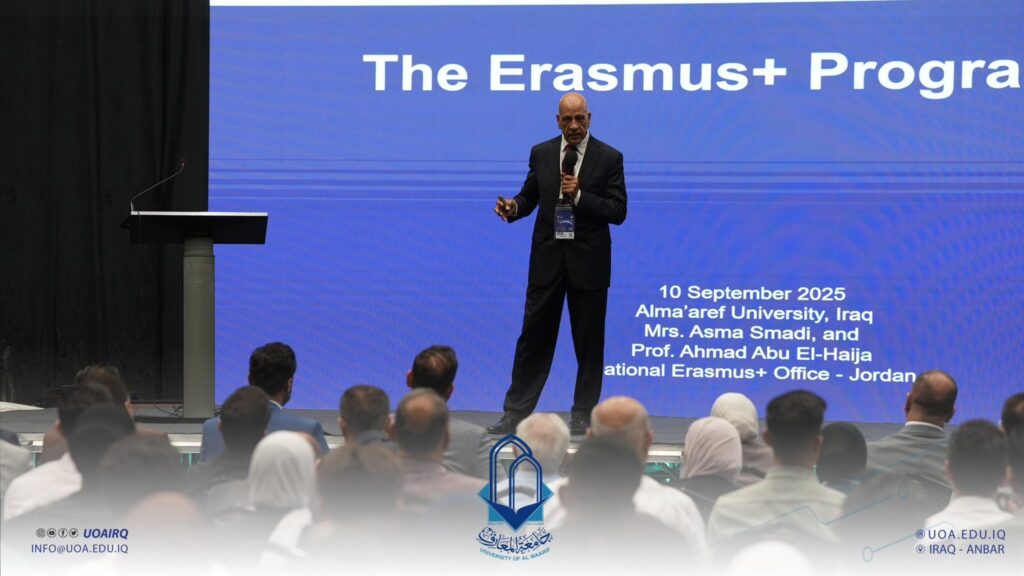
Public Lectures, Open Workshops, and Community Conferences
The University of Al-Maarif regularly organizes open community learning events, including:
Public awareness seminars
Scientific lectures
Cultural dialogues
Continuing education workshops
Youth empowerment programs
Educational festivals and public symposiums
These events are free of charge and frequently feature:
Distinguished university professors
Guest academics from national and international institutions
Professionals from government, medicine, law, engineering, business, and civil society
Event themes commonly cover:
Sustainable development and social responsibility
Digital literacy and emerging technologies
Mental and public health awareness
Educational innovation and pedagogy
Environmental preservation and climate awareness
Community ethics, leadership, and citizenship building
By providing knowledge for the public, UOA reinforces the role of universities in community enlightenment and civic learning, aligning with SDG Target 4.5 (reducing disparities) and SDG Target 4.7 (education for sustainable development).
Sustainability and E-Learning Platforms for Open Public Access
UOA has developed open digital platforms that host:
Awareness campaigns
Educational guides
Recorded student training workshops
Instructional materials for teachers and youth mentors
Sustainability research publications
The Sustainability and Global Ranking Unit website provides:
Meanwhile, the E-Learning Platform supports:
Virtual workshops for the community
Online skill-development courses
Open discussion forums led by faculty experts
These platforms are designed to:
Remove geographical barriers to education
Encourage self-paced learning
Promote digital literacy across age groups
Expand educational participation beyond the university population
Partnerships With Local Schools and Educational Institutions
UOA collaborates extensively with:
Public and private schools
Teacher training institutes
Educational district departments
Youth organizations
Local NGOs
Partnership activities include:
Free teacher training sessions on modern pedagogy
Workshops on classroom management and child psychology
Student mentorship and tutoring programs
Donations of educational materials
Career guidance days for secondary school students
School visits to university laboratories and lecture halls
This strengthens school-university integration and supports the development of educational continuity pipelines, in which students progress from primary and secondary stages into higher education with greater readiness and confidence.
Supporting Lifelong Learning and Adult Education
UOA recognizes that learning is not limited to the early stages of life.
The university therefore provides opportunities for adults, working professionals, retired individuals, and community learners through:
Evening and weekend academic workshops
Public access lecture series
Continuing professional development (CPD) courses
Open certification offerings in selected fields
Training on digital literacy and research methodology
These programs support:
Workforce development
Economic inclusion
Professional advancement
Community empowerment
They directly promote SDG Target 4.3 (access to lifelong learning opportunities) and SDG Target 4.4 (skills for employment and entrepreneurship).